Tree Root Damage in Delaware: Foundations, Driveways & Pipes
Homeowners in Greenville, Hockessin, and Pike Creek call us about the same situation every summer. There's a new crack in the basement wall, the driveway has started to lift, and a big silver maple is standing fifteen feet from the house. The tree looks guilty. Usually it's only partly responsible, and the repair people expect isn't the one they actually need.
Explore Blue Rock's tree removal services in Delaware →
Key Takeaways
- Roots rarely fracture sound concrete. Purdue University Extension describes roots as damaging a foundation only "with an invitation to do so," meaning a crack or joint that's already there.
- Most national advice on this topic is written for expansive-clay regions. Northern New Castle County sits on Piedmont soil, where that failure mode is far less common.
- A 2025 peer-reviewed study of one municipal network found root intrusion affecting about 20% of sewer mains and 23.8% of stormwater lines.
- Under Wilmington City Code Chapter 46, you're responsible for maintaining the street tree on your curb strip, and you still need a city permit to remove it.
- Cutting major roots to save a driveway is how a repair becomes a hazard. We've been assessing that tradeoff on north Wilmington properties since 2017.
Can Tree Roots Actually Crack a Foundation?
Rarely, and almost never by themselves. Purdue University Extension frames the mechanism bluntly: roots damage a foundation "with an invitation to do so." They find a crack, a joint, or a gap that already exists, then widen it as they grow in diameter. A root doesn't generate the force needed to split intact concrete. Wood loses that contest.
That's the part most homeowners have backwards. The root you can see wedged into a basement wall is usually evidence of an older problem, not the cause of it. Something else opened that gap first (settling, frost, poor drainage, a failed mortar joint), and the root simply followed the moisture and oxygen leaking through it.
There is a second mechanism, and it's the one that produces the dramatic before-and-after photos on foundation-repair websites. In soils with high shrink-swell capacity, roots pull large volumes of water out of the ground during dry spells. The clay contracts, voids open beneath the footing, and the structure loses uniform support. The British Geological Survey classifies this shrink-swell behavior as one of the most damaging geohazards for buildings. It's real. It's also highly regional, which brings us to Delaware.
Tree roots do not typically fracture sound concrete foundations. Purdue University Extension characterizes root-related foundation damage as requiring "an invitation": a pre-existing crack, joint, or void that roots subsequently exploit and widen through radial growth. The more significant indirect mechanism is soil moisture extraction in shrink-swell (expansive) clay soils, where root uptake causes soil contraction and loss of uniform footing support. (Sources: Purdue University Extension; British Geological Survey, Shrink-Swell Clay)
Why Delaware's Soil Changes the Answer
Northern New Castle County sits above the Fall Line. According to the Delaware Geological Survey, the Piedmont province dips southeastward beneath Coastal Plain sediments along a fall zone running from north of Newark to north of the Christina River in Wilmington. North of that boundary you get Piedmont soils over crystalline bedrock. South of it you get unconsolidated sand, silt, and clay.
Almost every article ranking for "tree roots foundation damage" was written by a foundation-repair company in Texas, Oklahoma, or North Texas specifically, where expansive clay drives an enormous repair industry. We've read those pages, and homeowners in Talleyville and Brandywine Hundred quote them back to us. The advice doesn't transfer cleanly. The shrink-swell soil profile that makes a Dallas slab heave is not what's under most north Wilmington properties, and we've never taken a tree down here purely because it was drying out expansive clay under a footing.
That's genuinely good news, but it isn't a clean bill of health. Northern Delaware trades one vulnerability for another. This is an old housing stock, and plenty of homes in Wilmington, Arden, and the older sections of Brandywine Hundred sit on fieldstone, brick, or block foundations with mortar joints. Those walls offer roots exactly the invitation Purdue is describing. A poured slab from 1998 in Hockessin is a much harder target than a 1920s stone cellar wall.
So the honest version for this area: worry less about a root levering your foundation apart, and more about what roots do to everything else buried in a Delaware yard.
Where Roots Really Do the Damage Here
Underground pipes, and it isn't close. A 2025 peer-reviewed study of an Australian municipal network (Orange City Council) found tree root intrusion affecting roughly 23.8% of stormwater lines, 20% of sewer reticulation mains, and 26.1% of sewer trunk mains, with older asbestos-cement pipe faring worst. Different continent, same mechanism. Roots follow the moisture and oxygen escaping from pipe joints, then expand inside the line.
The vulnerable pipe in your case usually isn't the municipal main. It's the lateral running from your house to the street. In most jurisdictions that lateral belongs to the property owner for its entire length, which means a root-choked line is your bill, not the county's. Confirm the specifics with your municipality or New Castle County before assuming either way, because the boundary varies.
Then there's the insurance trap. Standard homeowners policies generally exclude damage from root intrusion, because insurers treat it as gradual and preventable rather than sudden and accidental. Read your policy before you count on coverage.
Above ground, the everyday version of this problem is hardscape. Shallow-rooted species lift driveways, walkways, patios, and pool decks as their surface roots thicken. That's the damage we're actually called out for most often in north Wilmington, and it's the one homeowners notice first because they trip on it.
"They were efficient, fast, and were careful not to damage my lawn, irrigation system, and underground water infiltration system." — Paul K, Delaware
That review describes a six-tree, two-day removal, and it names the thing that matters on a root job. Anything worth protecting on a Delaware property is usually buried: irrigation lines, invisible fence, drainage, gas, the sewer lateral. Knowing where those run before equipment moves is most of the work.
Who Pays When Roots Lift Your Sidewalk in Wilmington?
You do, in most cases, and the rules catch people off guard. Under Wilmington City Code Chapter 46, the adjacent property owner is responsible for maintaining the street tree in the right-of-way, and the city separately places the duty to repair abutting public sidewalks on the adjoining landowner. The tree in the curb strip may as well be yours for purposes of cost.
Except when you want it gone. The city's Urban Forestry Program keeps regulatory control through the Urban Forest Administrator, and removing a street tree requires a permit that's generally granted only when the tree is hazardous, usually with a replacement requirement attached.
That combination is the most frustrating thing we explain to Wilmington homeowners. You maintain the curb-strip tree, you pay to fix the sidewalk its roots keep lifting, and you can't simply decide to remove it. The city's own guidance points toward repairing around the tree where possible and considers removal only when the growing space is genuinely too small or when saving the sidewalk would mean cutting so many structural roots that the tree becomes unstable. That last condition is the one worth arguing on the merits, and it's an argument you want documented before the work starts.
If you're not sure which side of the property line your tree sits on, our Delaware tree removal permit guide breaks down all five jurisdictions that might have a say.
Which Trees Cause the Most Root Trouble in Delaware Yards?
A short list does most of the damage. Silver maple, willow, and poplar are the repeat offenders, and elm and sycamore aren't far behind. Hybrid poplar roots can spread to roughly twice the tree's height, and willows are specifically drawn to leaking sewer, septic, and irrigation lines. Silver maple is the one we encounter most in this area, partly because it grows fast and got planted heavily in postwar developments, and partly because its surface roots go straight for driveways.
On spacing, the general guidance is at least 10 feet from a foundation for a typical shade tree, and 25 to 50 feet for aggressive-rooted species. Treat those numbers as a floor rather than a guarantee. A mature oak's root system extends well past its drip line, and a tree planted at a "safe" distance in 1975 has had fifty years to change the arrangement.
"Their quote was very reasonable and I am impressed they were able to take down two trees in the small space between my neighbor and I without damaging the stockade fence on the property line that was practically touching the huge trees." — Brett Saddler, Delaware
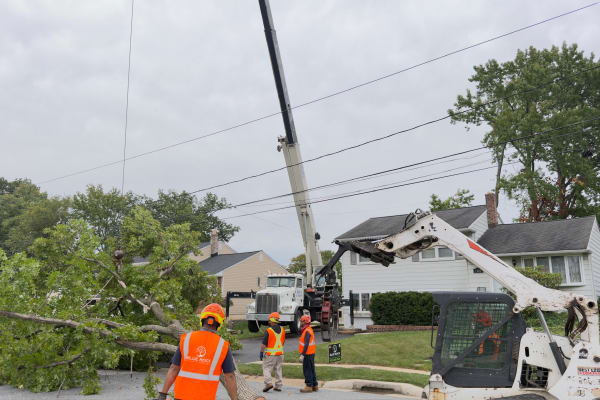
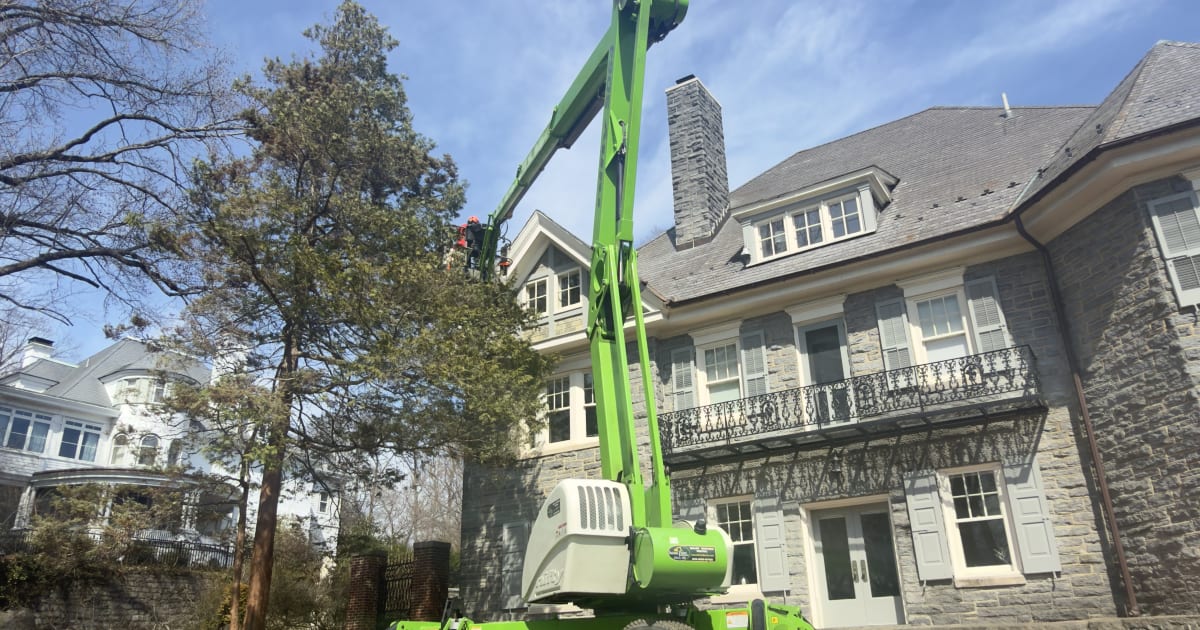
Tight lot lines are the norm across Pike Creek and Brandywine Hundred, and they're why we run a compact SD64 spider lift alongside conventional equipment. It reaches over fences and structures with minimal ground pressure, which matters a great deal when the thing you're trying not to disturb is the soil around a foundation.
If you're replanting after a removal, our guide to the best trees to plant in Delaware covers species that won't repeat the problem.
Should You Remove the Tree or Repair the Damage?
Start by separating the tree question from the structure question, because they have different answers and different contractors. The most expensive mistake we see is a homeowner hiring someone to sever major roots to save a driveway, then discovering they've traded a cracked apron for a tree that's no longer anchored.
Our rule of thumb after nine years of these calls: if saving the hardscape requires cutting structural roots inside roughly three to five times the trunk's diameter from the base, you're no longer choosing between removal and repair. You're choosing between planned removal now and unplanned failure in the next nor'easter. We'd rather tell a homeowner in Greenville that on a clear day in August than get the emergency call in January.
When the tree is otherwise healthy and well-placed, repair usually wins. A root-intruded lateral can often be cleared and relined without touching the tree. Lifted hardscape can be reset, or rebuilt with a flexible surface and a root path designed in. Root barriers exist and work best when installed before roots arrive, though their effectiveness on mature trees is genuinely debated and cutting a trench for one carries the same stability risk as any other root pruning.
When the tree is already declining, structurally compromised, or a species that will simply do this again, removal is the honest recommendation. Our guide to the warning signs a tree needs to come down covers what to look for, and the Delaware tree removal cost guide explains what the work runs.
One thing we won't do is guess at your structure. We assess the tree, the roots, and the risk of working near what's buried. A plumber should scope the lateral, and a foundation contractor should evaluate the wall. Anyone offering to diagnose all three from the driveway is selling something.
What Removal Involves When Roots Are the Problem
Taking the tree down doesn't remove the roots. That surprises people. The stump and root system stay in the ground and decay over years, which is fine under a lawn and a problem under anything you plan to build, pave, or plant.
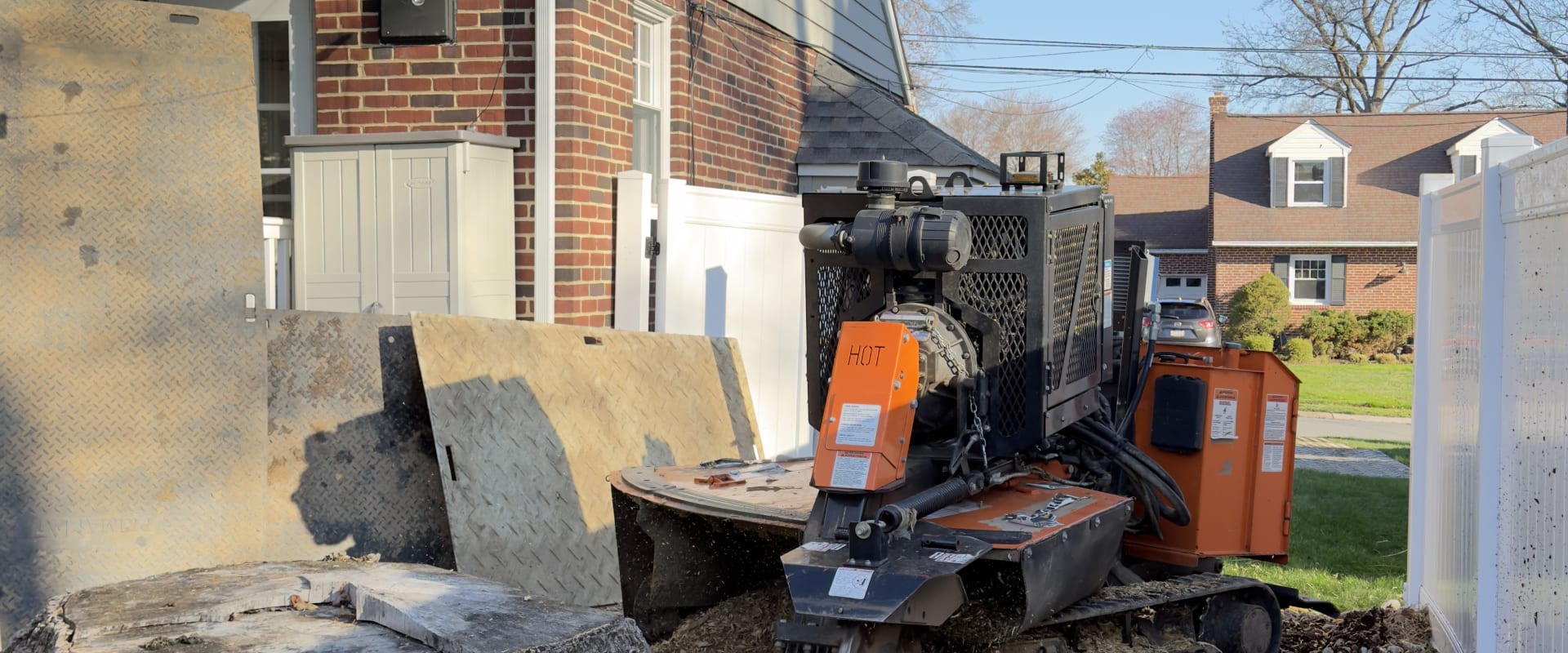
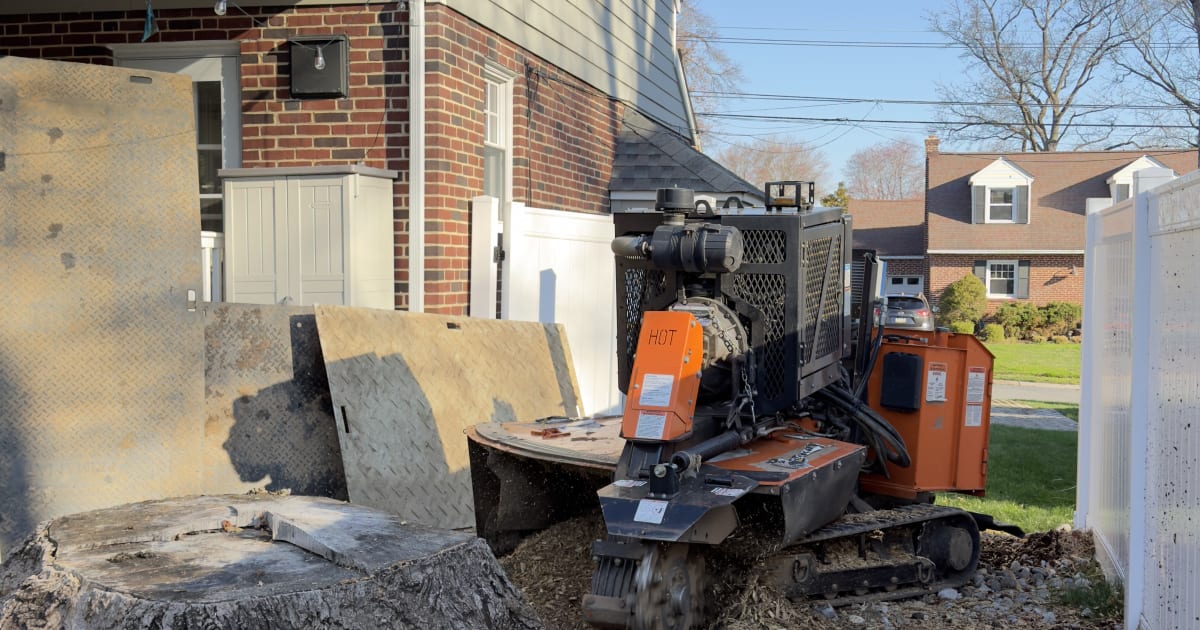
That's why root-driven removals almost always pair with stump grinding. On a job in Wilmington we ground a large stump immediately beside the house, with heavy boards protecting the siding and windows, taking multiple passes well below grade so nothing regrew and the area was ready for new landscaping. Grinding depth matters here. Shallow grinding leaves the woody mass that keeps feeding the same settling and pest problems you were trying to end.
"After the tree was down, and the stump was ground up, they cleared away the sawdust and wood chips, replacing it with top soil." — Diane Finocchiaro, Local Guide
Get a free estimate for your Delaware property →
Frequently Asked Questions
How far should a tree be from my house in Delaware?
Ten feet is the common minimum for a typical shade tree, and 25 to 50 feet for aggressive-rooted species like silver maple, willow, or poplar. Those figures assume mature size, so check the species' full spread rather than how it looks today. Existing trees closer than that aren't automatically a problem.
Do tree roots really crack foundations?
Rarely on their own. Purdue University Extension describes roots as needing "an invitation," meaning a crack or joint that already exists, because they can't generate enough force to break sound concrete. The bigger indirect risk is soil moisture extraction in expansive clay, which is much less of a factor in northern Delaware's Piedmont soils than in the southern and southwestern states most articles are written about.
Does homeowners insurance cover tree root damage to pipes?
Usually not. Standard policies generally exclude root intrusion because it's treated as gradual, preventable damage rather than a sudden accident. Sewer laterals are also typically the property owner's responsibility for their full length to the main. Check your specific policy and confirm the lateral boundary with your municipality.
Do you service Brandywine Hundred and Talleyville, DE?
Yes. Brandywine Hundred and Talleyville are core parts of our service area, and their mix of mature postwar trees and tight suburban lots produces a lot of root-and-hardscape work. We also cover Greenville, Hockessin, Pike Creek, Centreville, Arden, Claymont, Newark, and New Castle.
Can I remove the tree on my curb strip in Wilmington if it's wrecking my sidewalk?
Not without a city permit. Under Wilmington's Urban Forestry rules, a street tree in the public right-of-way can generally only be removed if it's hazardous, and replacement is usually required, even though City Code Chapter 46 makes you responsible for maintaining it and for repairing the sidewalk. Start with the Urban Forest Administrator before scheduling any work.
How quickly can you look at a tree that's damaging my driveway in north Wilmington?
For non-emergency assessments we typically schedule within a few days across north Wilmington. If a tree is leaning, has visible root plate lifting, or came through a storm, call us at 302-408-0626. We run emergency service 24 hours a day, 7 days a week.
Will grinding the stump get rid of all the roots?
No. Grinding removes the stump and the major root flare below grade, but lateral roots remain and decay over several years. That's fine under lawn. If you're pouring a patio, laying pavers, or planting a replacement tree in the same spot, tell us during the estimate so we can grind deeper and excavate the roots that would otherwise be in the way.
Get a Free Root Damage Assessment in Delaware
If a tree near your foundation, driveway, or sewer line has you worried, the useful first step is having someone look at the tree and the site together. We've been doing that across Greenville, Hockessin, and Brandywine Hundred since 2017, we're licensed and insured, and we carry a 4.9-star rating from 85 Google reviews. We'll tell you honestly when the tree can stay.
Call us at 302-408-0626 or request a free estimate online. For urgent situations, we're available 24 hours a day, 7 days a week.
Explore Blue Rock's full range of tree care services in Delaware →