Do You Need a Permit to Remove a Tree in Delaware? (Wilmington & New Castle County Guide)
Most of the homeowners who ask us this are bracing for a bureaucratic headache that, in their case, usually doesn't exist. If the tree is in your own yard in Greenville, Hockessin, or Pike Creek, you almost certainly don't need a government permit to take it down. The rules that trip people up are the narrow ones: a tree on the curb strip, a lot inside the City of Wilmington, a job that spills into a state road, or an HOA that wants a say.
This guide breaks the question down by who actually has authority, because "Delaware" isn't one rule. It's five different jurisdictions, and each one controls a different kind of tree.
Explore Blue Rock's tree removal services in Delaware →
Key Takeaways
- Delaware has no statewide permit to remove a tree on your own private property. State law (Title 25, Ch. 14) only penalizes cutting someone else's trees.
- The City of Wilmington requires a free permit for street trees in the public right-of-way, but not for trees on private property (Wilmington Urban Forestry).
- New Castle County does not issue a homeowner tree-removal permit for a private yard tree. Its tree rules apply to land development, not your backyard.
- Roughly 78% of Delaware's forest is privately owned (USDA Forest Service), so most removal decisions sit with homeowners, not an agency.
- Even with no government permit, your HOA's covenants may still require approval before the saw starts.
Do You Need a Permit to Remove a Tree on Your Own Property in Delaware?
For a tree on your private residential lot, no. Delaware has no statewide law that requires a permit to remove it. The state regulates tree cutting only after the fact, through civil "timber trespass" liability under Delaware Code Title 25, Chapter 14, which exists to punish someone who cuts down a tree that isn't theirs. It is not a removal permit, and it doesn't apply to a tree you own.
That tracks with how Delaware's tree cover is actually held. According to the USDA Forest Service, about a third of the state is forested and roughly 78% of that forest is privately owned. Most of the trees in Delaware are somebody's private property, and the law treats them that way. The decision to keep or remove one is generally the owner's to make.
More of those private trees are coming down lately for one reason in particular: emerald ash borer. First detected in New Castle County in 2016, the beetle had spread widely enough that the Delaware Department of Agriculture classified the state as generally infested by 2023, leaving stands of dead, brittle ash that have to be removed. For most of those trees the question isn't whether you're allowed to. It's whether you need to ask anyone first.
Delaware imposes no statewide permit requirement to remove a tree on private residential property. The only state statute governing tree removal, Title 25, Chapter 14 of the Delaware Code, addresses civil liability for "timber trespass" (cutting another person's trees without consent) and provides for both actual and exemplary damages. It does not regulate a property owner removing their own tree. (Source: Delaware Code, Title 25, Ch. 14, delcode.delaware.gov)
There are two real exceptions worth knowing before you assume you're clear. The first is environmentally protected land: wetlands and subaqueous lands are regulated by DNREC, and parcels with streams, steep slopes, or floodplains can carry restrictions. The second is where your tree sits. If it's in the public right-of-way rather than your yard, or you're inside a city with its own ordinance, a different set of rules takes over. Those are the cases the rest of this guide covers.
If you're still deciding whether a tree even needs to come down, our guide to the warning signs a tree needs removal is a good first read.
When Does the City of Wilmington Require a Permit?
Inside Wilmington city limits, the line is drawn between street trees and private trees. The city's Urban Forestry Program requires a permit to plant, remove, or even prune (branches larger than 2 inches) a street tree in the public right-of-way, and it explicitly does not require one for trees on private property.
Here's the part that surprises people. That strip of grass between the sidewalk and the curb is usually public right-of-way, and the tree growing in it is a regulated street tree even though it's directly in front of your house. Under Wilmington City Code Chapter 46, the adjacent property owner is responsible for maintaining those trees, but the city keeps regulatory control through the Urban Forest Administrator.
"A permit is required for street tree planting, street tree removal and pruning of tree branches larger than 2 inches in diameter. A permit is not required for private property trees." — City of Wilmington Urban Forestry
The process is straightforward and free. You submit the request to the Urban Forest Administrator at Public Works, they do a site visit, and you get a written decision, typically in about two weeks. A street tree can only be removed if it's hazardous, and it generally has to be replaced. If you're denied, you can appeal in writing within 10 days to the Tree Commission. To start one, dial 311 inside the city or call (302) 576-2620 from outside. The city has earned Tree City USA recognition for more than 25 years, so it takes its canopy seriously.
The single most common mistake we see inside Wilmington isn't on private lots. It's a homeowner assuming the tree on the curb strip is "theirs" because they've mowed around it for years. It isn't, for permitting purposes. We always check whether a tree sits in the right-of-way before we quote a city job, because the permit path is completely different on either side of that curb line. That same curb-strip tree is usually the one lifting the sidewalk you're on the hook to repair, which we break down in our guide to tree root damage to foundations, driveways, and pipes.
What About New Castle County: Greenville, Hockessin, Pike Creek, and Brandywine Hundred?
If your home is in unincorporated New Castle County, which covers most of Greenville, Hockessin, Pike Creek, Brandywine Hundred, and Talleyville, then the county does not issue or require a homeowner tree-removal permit for a tree on your private property. The county's tree and landscape rules live in its Unified Development Code (Chapter 40), and they bind land development like subdivisions and site plans, not a homeowner taking down a single backyard tree.
There are conditions that change that, though, and they're worth five minutes of checking. The UDC protects riparian buffers, Water Resource Protection Areas, floodplains, steep slopes, and wetlands, and it requires forest and tree cover to be preserved on parcels going through development. So removal can be restricted if your lot sits in one of those protected areas or carries a recorded subdivision landscape plan from when the community was built.
In our work across Greenville, Hockessin, and Pike Creek, the homeowners who call the county worried about a "permit" almost always find the county isn't the obstacle. Their HOA's recorded landscape plan is. We've walked plenty of properties where the county had no requirement at all, but the community's declaration controlled which trees could come out. If you're not sure which applies to your lot, the county Department of Land Use (302-395-5400) can tell you whether a recorded plan or protected resource is attached to your parcel.
One more point of confusion worth clearing up: the City of New Castle is a small, separate historic municipality, not the same thing as New Castle County. It runs its own Tree Advisory Commission, which meets monthly to review tree work, and its code (Chapter 210) requires a permit specifically for street trees: "No person shall, without a valid tree permit, remove, destroy, break, cut or deface any street tree." If you live in that town, call (302) 322-9801 before touching a street tree. For everyone in the wider county, that ordinance doesn't apply to you.
When Does a Tree Job Need a DelDOT Permit?
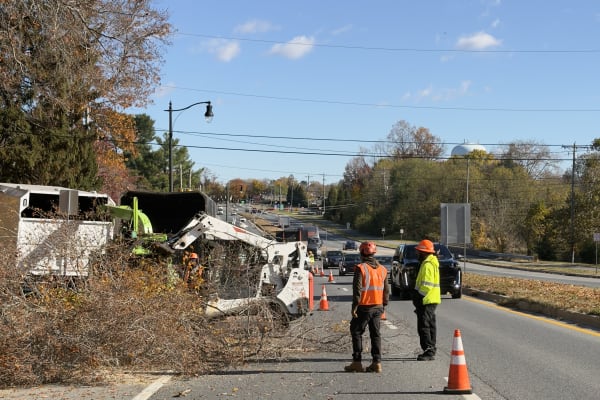
A DelDOT permit comes into play when the work affects a state-maintained road, for example when a tree is close enough that taking it down safely requires closing a lane or working inside the state right-of-way. In that case Delaware requires authorization from DelDOT, compliance with its lane-closure time restrictions, and a traffic-control setup based on the federal MUTCD standard. Importantly, that's the tree contractor's responsibility to arrange, not yours.
"Third parties... working in the right of way shall adhere to time restrictions for lane and road closures imposed via department permits for such work." — DelDOT Time Restriction Policy C-09
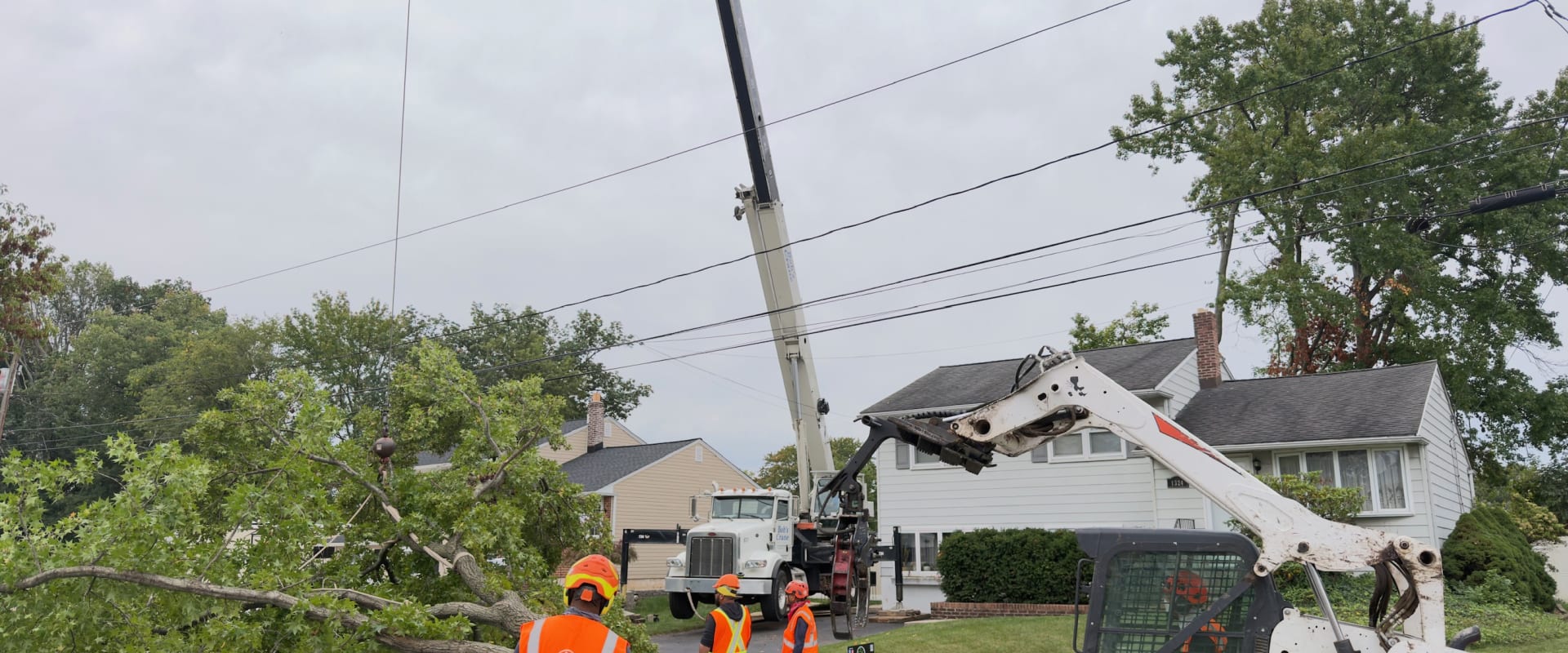
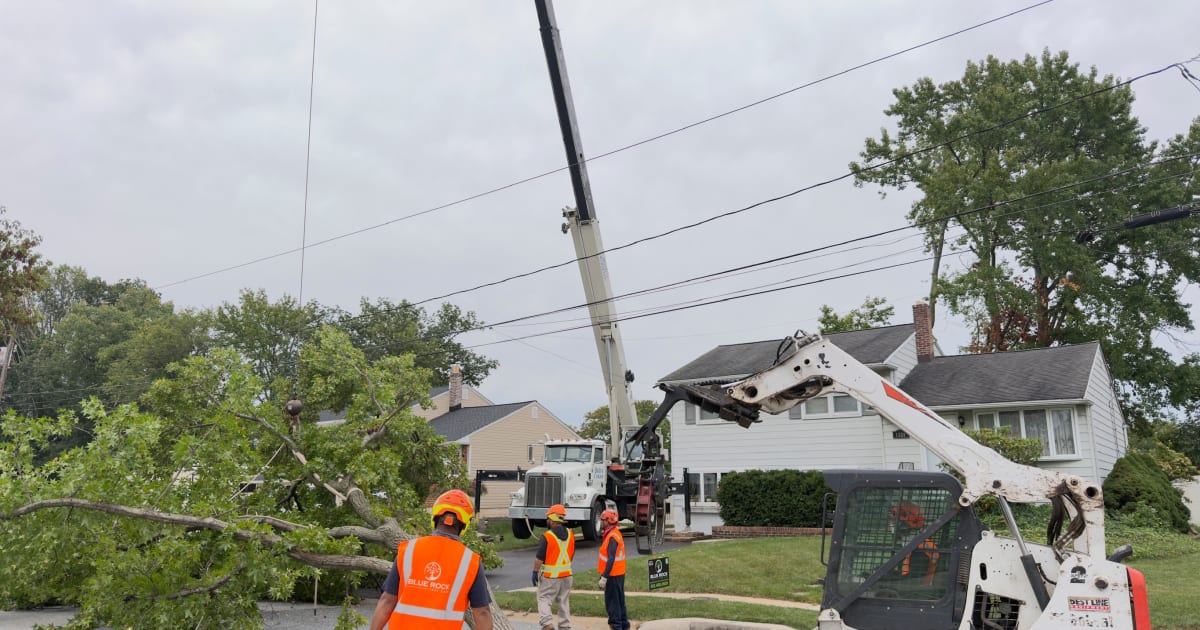
We've run this process start to finish. One of our more involved Wilmington jobs was a 90-foot oak leaning over a main road, with power lines on one side and storefronts on the other. It was the kind of removal that can only be done by crane, under a DelDOT-approved traffic-control plan, with certified flaggers on site. We pulled the permit, staged the closure, and had the road fully reopened the same day. The full story is in our writeup of that DelDOT-permit crane removal in Wilmington.
"With fences, play sets, and power lines surrounding the tree, they did an amazing job! Highly recommend." — Joanne Ott, Delaware
What this means for you as a homeowner is simple. If a tree service tells you your roadside job needs a DelDOT permit and flaggers, that's not an upsell. It's the law, and a crew that skips it risks a stop-work order and a fine. The exact application is administered through the New Castle County district office (302-326-4679), and any legitimate contractor will handle it for you.
Does Your HOA Have to Approve It, Even With No Government Permit?
Often, yes. This is the requirement that catches the most people, because it's separate from anything the state, county, or city does. Even when no government permit is needed, an HOA's recorded covenants frequently require approval from the Architectural Review Board (or Architectural Control Committee) before a homeowner removes a tree. It's a private contractual obligation, enforceable under your community's declaration, and it has nothing to do with a .gov permit office.
"They took the time to educate me about my options and helped create a strategy." — Blair Johnson, Local Guide
That kind of planning matters most in HOA communities, where removing the wrong tree (or the right tree the wrong way) can mean fines or a forced replacement. Delaware community associations generally operate under the Delaware Uniform Common Interest Ownership Act, but the actual tree rules are set by each community's own declaration, so there's no single statewide answer. The only reliable move is to read your covenants or ask your board. We cover this in depth in our guide to HOA tree removal in Delaware.
What Happens If You Remove a Tree Without a Required Permit?
The consequences depend on which rule you skipped, and they range from manageable to expensive. The most serious is cutting a tree that isn't yours. Under Delaware's timber-trespass statute (Title 25, Ch. 14), a property owner can recover both actual and exemplary damages for trees removed without consent, which is why a property-line tree should never come down on a guess about who owns it.
For the other categories, the exposure is more procedural but still real. Removing a regulated street tree without a city permit, or doing roadside work without DelDOT authorization, can trigger a stop-work order and fines to the contractor. An HOA can levy its own penalties or require you to replant. None of these are reasons to panic about a normal backyard removal. They're reasons to confirm, in advance, which of the five jurisdictions actually has a say over your specific tree.
"When a tree came down on our garage at our new house, we didn't know who to call. Neighbors recommended Blue Rock. They came out the very next day. Nick and Brandon were very professional." — Mallory Greene, Delaware
The good news is that for the large majority of Delaware homeowners, the answer to "do I need a permit?" is no. For the cases where you do, a reputable tree service handles the paperwork as part of the job.
Get a free, no-obligation estimate for your Delaware tree →
Frequently Asked Questions
Do I need a permit to remove a tree in my backyard in Wilmington, DE?
No. The City of Wilmington's Urban Forestry rules require a permit for street trees in the public right-of-way, but not for trees on private property. If the tree is in your yard, not the curb strip between the sidewalk and the street, you don't need a city permit to remove it. The curb-strip tree is the common exception, so confirm where the tree actually sits.
Do you service Greenville, Hockessin, and Pike Creek, DE?
Yes. Greenville, Hockessin, Pike Creek, and Brandywine Hundred are core parts of our service area, and we work in these communities every week. Many of the older estate lots here carry recorded subdivision landscape plans or HOA covenants, so we help homeowners confirm what approval (if any) their specific property needs before we schedule the work.
Who pulls the DelDOT permit for a roadside tree, me or the tree service?
The tree service does. When a removal affects a state-maintained road and requires a lane closure or work in the right-of-way, DelDOT authorization and a traffic-control plan are the contractor's responsibility, not the homeowner's. Blue Rock handles the permit, the certified flaggers, and the closure scheduling as part of the job.
Does New Castle County require a permit to remove a tree on private property?
No. New Castle County does not issue a homeowner tree-removal permit for a private yard tree. Its tree and landscape rules (in the Unified Development Code) apply to land development, not individual homeowners, unless your lot is in a protected riparian buffer, floodplain, or wetland, or carries a recorded landscape plan. The county Department of Land Use (302-395-5400) can confirm.
Do I need my HOA's approval to remove a tree in Delaware?
Often, yes, and this is separate from any government permit. Many Delaware HOA covenants require Architectural Review Board approval before a tree is removed, even on your own lot. Check your community's recorded declaration or ask your board first, because HOA fines and replacement requirements apply regardless of state or county rules.
What's the penalty for removing a tree without a permit in Delaware?
It depends on the rule. Cutting a tree that isn't yours exposes you to actual and exemplary damages under Delaware's timber-trespass statute (Title 25, Ch. 14). Removing a regulated street tree or doing roadside work without the right city or DelDOT permit can bring stop-work orders and contractor fines, and an HOA can impose its own penalties.
Can I remove the tree on the strip in front of my house?
Not on your own. In Wilmington and in the City of New Castle, the tree in the planting strip between the sidewalk and the curb is typically a street tree in the public right-of-way, and removing it requires a city permit. That's usually granted only if the tree is hazardous, and often with a replacement requirement. Start with the city before scheduling any work.
Get a Free Tree Removal Estimate in Delaware
Blue Rock has been removing trees across Wilmington, Greenville, Hockessin, and Pike Creek since 2017, and we navigate the permit side of these jobs all the time, from private backyard removals that need nothing to DelDOT road closures that need a full traffic-control plan. We're licensed, insured, and rated 4.9 stars across 85+ verified Google reviews, with nine years of hands-on experience. If you've got a tree you're unsure about, we'll tell you honestly whether a permit is even in the picture.
Call us at 302-408-0626 or request a free estimate online. For urgent situations, we're available 24 hours a day, 7 days a week.
Explore Blue Rock's full range of tree care services in Delaware →