How to Choose a Tree Service in Delaware: 7 Checks Before You Hire
The mature oaks in Greenville, the old-growth maples along Hockessin's ridgelines, the towering ash trees in Pike Creek neighborhoods — trees are the largest physical assets on most north Wilmington properties. Choosing the wrong company to work on them can cost you far more than the job itself. An uninsured crew working on your property leaves you personally liable for medical costs that can reach $50,000 to $200,000 if a worker is seriously injured (Insurance Opedia, 2026). A contractor with no real Delaware experience can turn a one-day removal into a months-long dispute with your HOA, a cracked retaining wall, or a tree that falls the wrong direction.
Here are seven checks every Delaware homeowner should run before any tree company picks up a single tool on your property.
Explore Blue Rock Tree Care's services for Wilmington, Greenville, and New Castle County →
Key Takeaways
- Always verify general liability AND workers' compensation before hiring — a worker injured on your property without workers' comp can make you personally liable for up to $200,000 in medical costs.
- Proper technique matters more than a low bid: a crew should follow recognized pruning standards (ANSI A300) and give honest, experience-based assessments before recommending removal.
- Storm chasers solicit door-to-door after weather events and account for a significant share of annual contractor fraud complaints; the Tennessee AG issued a formal scam alert for tree services in February 2026.
- Genuine local experience in Delaware means knowing the species, soil conditions, HOA rules, and Wilmington permit requirements that out-of-state crews often miss.
- A written estimate with no upfront payment is the baseline standard — anything else is a red flag.
Why Getting This Wrong Is More Expensive Than the Job Itself
Tree work is one of the most dangerous skilled trades in the country. The Bureau of Labor Statistics consistently ranks tree trimming and removal among the top ten most hazardous U.S. occupations — with a fatality rate roughly 15 times higher than the average American job. That danger makes proper insurance non-negotiable, and it's exactly why corner-cutting operators skip it.
In 2026, the Better Business Bureau issued warnings about storm-related contractor fraud in multiple states (BBB, 2026). That same year, the Tennessee Attorney General's office released a formal consumer alert specifically about tree trimming and removal scams targeting homeowners after severe weather events (Tennessee AG, February 2026). Storm chasers — unlicensed contractors who follow storm tracks and knock on doors — collect deposits and vanish, do work so poor it requires a second company to redo it, or do substandard work and disappear when you call for follow-up.
The risk compounds in north Wilmington specifically. Greenville lots sit tight against stone walls and neighboring estates. Hockessin properties have steep grades and limited truck access. Pike Creek neighborhoods mix older overhead utility lines with mature canopy that took decades to grow. Work done without the right knowledge, equipment, and accountability doesn't just cost money — it puts property and people at risk.
According to the National Insurance Crime Bureau, contractor fraud surges following major storm events, with unlicensed tree service operators among the most common subjects of BBB complaints. The Tennessee Attorney General issued a formal consumer alert on tree removal scams in February 2026, warning homeowners that contractors soliciting door-to-door after storms are at significantly higher fraud risk than established local businesses.
Check 1: Do They Carry General Liability AND Workers' Compensation?
The single most important question to ask before any tree service touches your property — and most homeowners ask it wrong. "Are you insured?" isn't enough. You need to ask about two completely separate policies, because a general liability policy alone does not protect you.
General liability covers damage to your property if the crew makes an error — a fallen limb that cracks your roof, a truck that tears up your lawn. Workers' compensation covers the crew if they're injured while working on your property. Without workers' comp, a worker who falls from a tree in your backyard in Greenville or Hockessin can sue you personally. Medical costs for serious tree work injuries routinely reach $50,000 to $200,000 (Insurance Opedia, 2026), and your homeowner's insurance policy is unlikely to cover a gap created by a contractor you hired.
Ask for a Certificate of Insurance (COI) — not a verbal assurance, not a screenshot. A real COI comes from the insurance company, lists both policy numbers, shows coverage amounts, and displays the policy expiration date. Ask to be named as an additional insured for the duration of the work. Any reputable company will provide this without hesitation. Hesitation itself is the answer.
In north Wilmington, we've spoken with homeowners who nearly hired a crew that produced a one-page summary document — not an actual certificate. A valid COI can be verified with a quick phone call to the insurer's number on the document. It takes two minutes and eliminates an enormous liability.
Blue Rock Tree Care carries comprehensive general liability and workers' compensation coverage on every job in Delaware, Pennsylvania, and Maryland. We provide certificates on request before work begins — no exception.
Check 2: Do They Have Real Experience and Use Proper Technique?
Tree work rewards experience. The number of years a crew has spent in the field — across different species, tree sizes, and access conditions — is one of the best predictors of whether your job goes smoothly. The recognized technical standard for the trade is ANSI A300, published by the American National Standards Institute, which defines proper pruning, cabling, and removal practice. A good company follows it whether or not anyone on the crew carries an optional certification, and the International Society of Arboriculture (ISA) publishes the best-management practices that put A300 to work in the field.
Why does technique matter for your trees? An inexperienced crew may use improper pruning cuts that create large, open wounds inviting disease. They may recommend removing a tree that could be saved through targeted pruning — or, more dangerously, leave standing a tree that's already at high structural risk and needs to come down. An experienced crew working to A300 follows scientifically grounded technique, not guesswork.
When you talk to any tree company you're evaluating, ask specifically: "How many years has your crew been doing this, and will an experienced person assess my trees before any work is recommended?" Ask what pruning standard they follow and how they decide whether a tree should be saved or removed. A company that can speak clearly about technique and walk you through its reasoning is showing you the competence that actually matters.
The recognized technical standard for tree care in the United States is ANSI A300, which defines accepted practice for pruning, cabling, and removal. Reputable tree companies follow A300 and the International Society of Arboriculture's best-management practices, and pair that with proper licensing, general-liability and workers'-compensation insurance, and documented hands-on experience in the local area.
Check 3: Can They Show Local References in Your Area?
Delaware has specific tree species, soil types, and municipal permit requirements that differ meaningfully from neighboring states. A company operating primarily in Pennsylvania or Maryland may not know that Wilmington requires a permit for street tree work, that New Castle County HOAs have their own approval processes, or that the heavy clay soils across Brandywine Hundred affect how root systems fail under storm load.
Ask for references from customers in communities similar to yours — specifically in Greenville, Hockessin, Pike Creek, or Brandywine Hundred if that's where your property is. An established local company should provide several without hesitation. Check Google reviews specifically, and look for mentions of your neighborhood or community. That geographic specificity confirms the company is a real local operator, not a crew traveling through after a storm.
Real customer experiences tell you more than any company website. Blair Johnson, a local customer who hired Blue Rock after three other contractors didn't show up, described what actually separates good companies from the rest:
"I had tried three other contractors that didn't even show up. Nick and his team were communicative, fair priced, and professional. They took the time to educate me about my options and helped create a strategy. Once they removed the large dead tree, their clean up was immaculate. They made a stressful situation calm."
Anthony Kelly of Wilmington had a similar experience after a trimming and cleanup job:
"From the first consultation to the final cleanup, their team was professional, knowledgeable, and easy to work with. They carefully trimmed and removed branches without damaging any surrounding landscaping, and they left my yard cleaner than it was before they arrived. You can tell they genuinely care about the health of the trees and the satisfaction of their customers."
Responsiveness, cleanup, and honest communication are patterns you'll see in reviews of companies that operate with real accountability. When those things don't appear in reviews — or when reviews are thin and generic — that tells you something too.
Check 4: Do They Have the Right Equipment for Your Property?
Tree work is equipment-intensive, and the right tools depend entirely on your specific property. A single truck with a chainsaw is fine for an open-access rural job. It's inadequate — and potentially dangerous — for the kind of residential work that defines most of north Wilmington.
Here's what a fully equipped local tree service should have access to:
Debris chipper and hauling: Cleanup should be included in every job. A crew that leaves wood and brush behind is either underprepared or planning to upcharge for something that should be standard.
Bucket truck or aerial lift: Required for large canopy work, precise limb rigging, and safe working height in most residential settings.
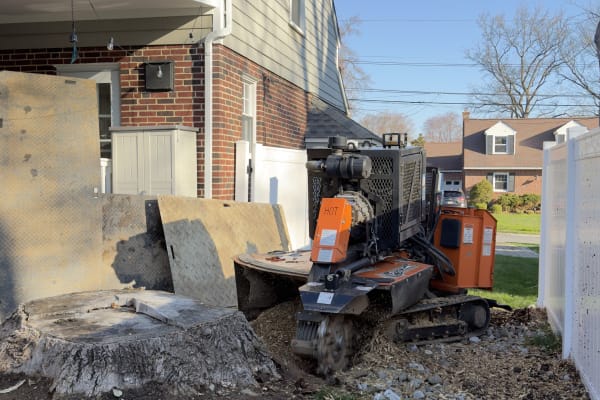
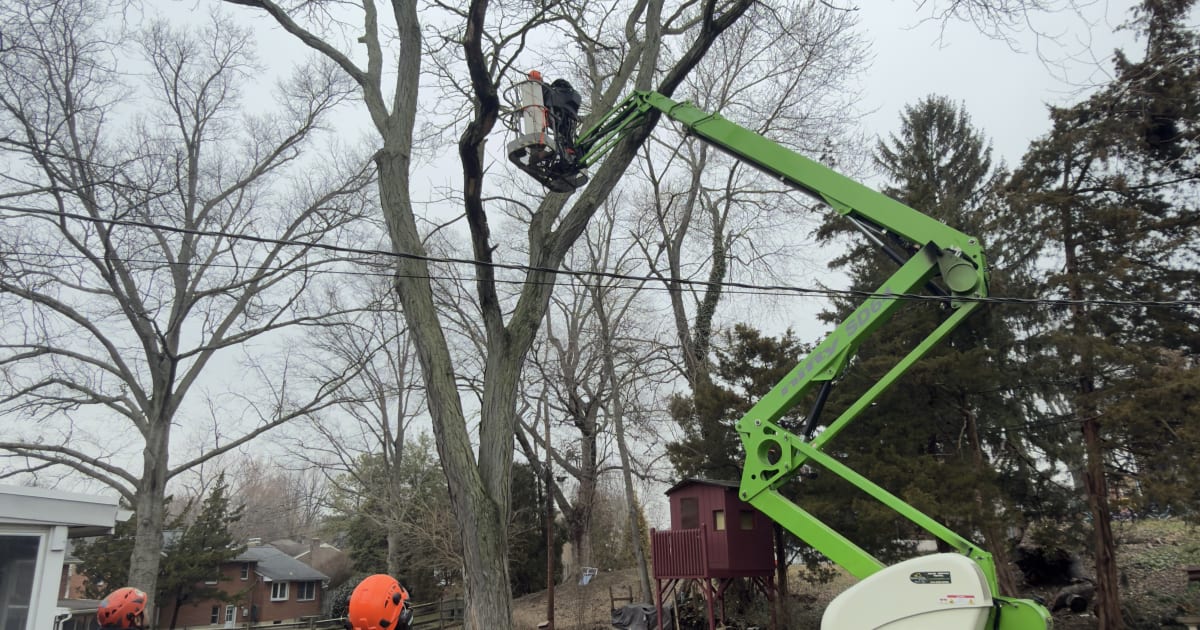
Compact spider lift: Critical for tight lots in Hockessin, Greenville, and older Wilmington neighborhoods where gates are narrow, lawns are delicate, and standard bucket trucks cause more damage than they fix. Blue Rock's SD64 spider lift was engineered for exactly these conditions — narrow access, minimal ground pressure, capable of operating safely over lawns, hardscape, and rooftop edges without damaging what's underneath.
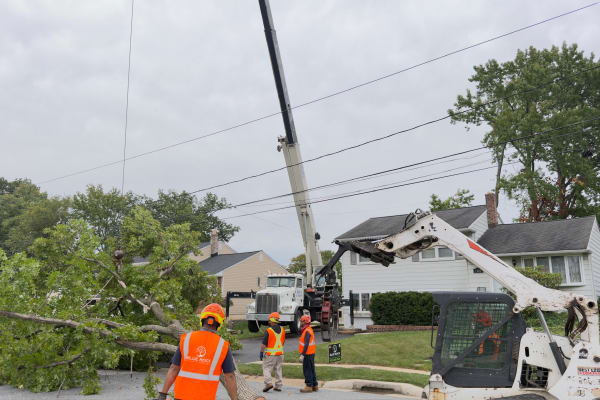
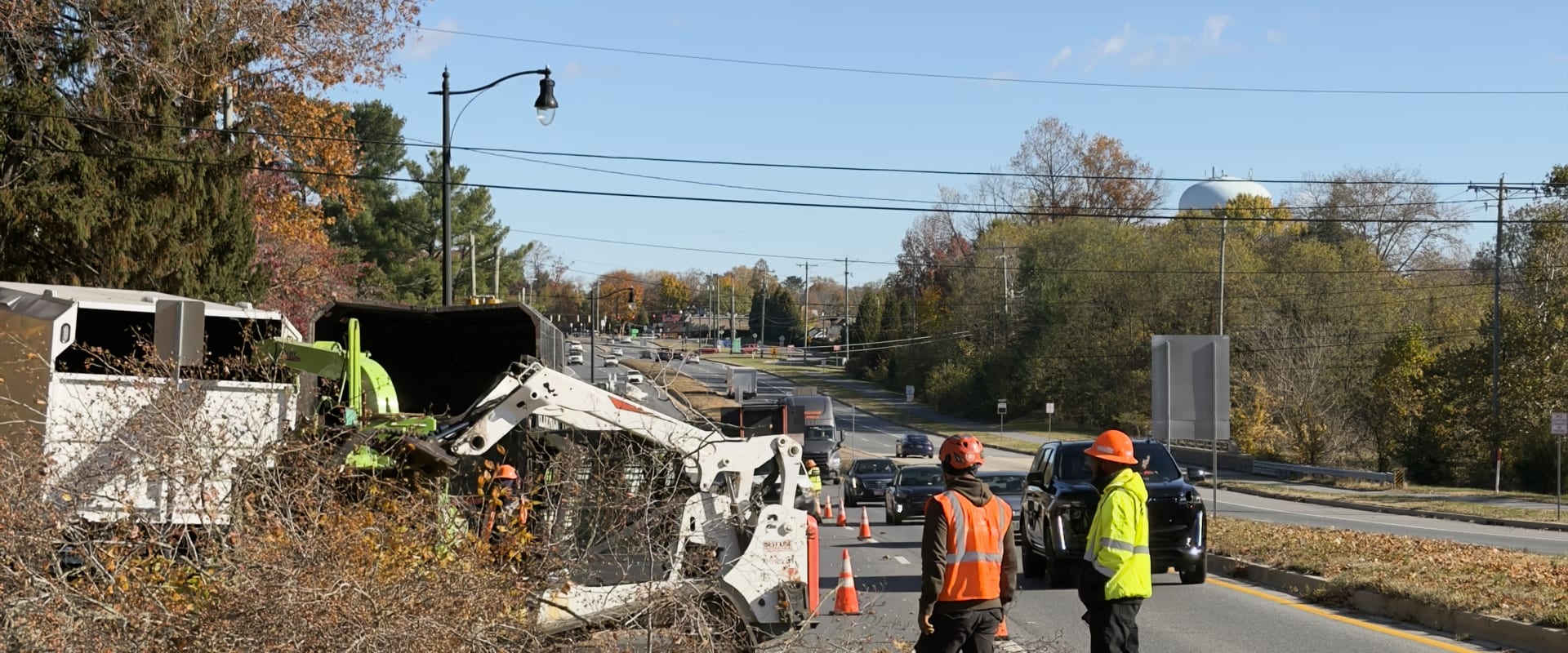
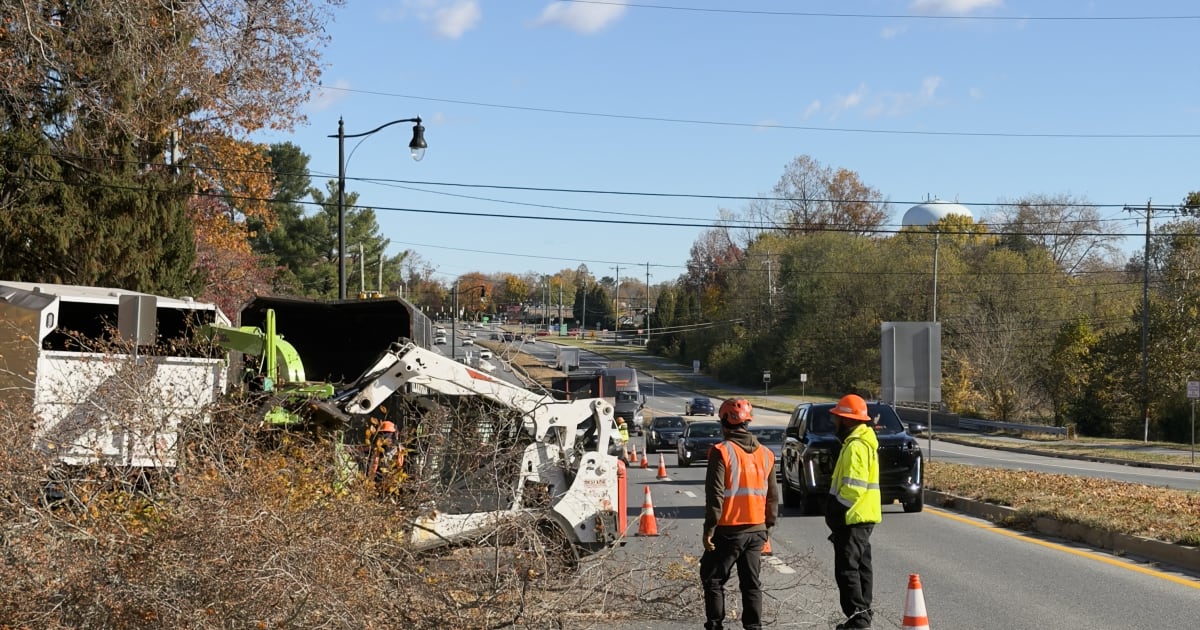
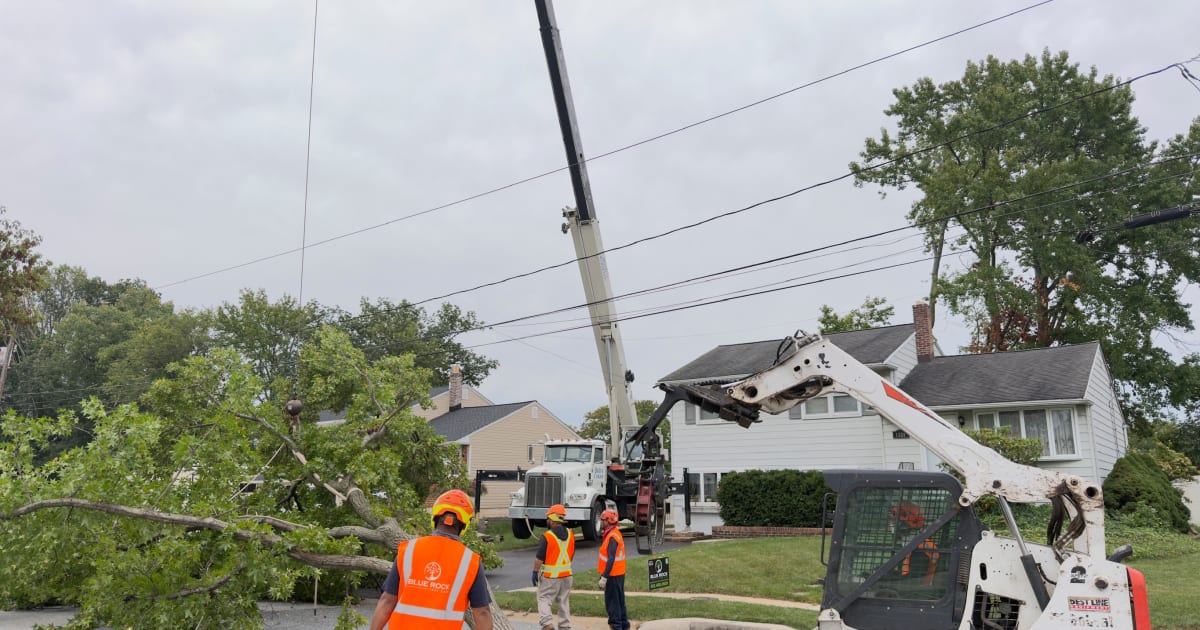
Crane capability: For complex hazardous tree work near structures, power lines, and public roads. Blue Rock has performed crane-assisted removals in Wilmington under full DelDOT lane closure permits with certified traffic flaggers — a job that requires coordination, permits, and equipment that most local crews simply can't provide.
In properties across Hockessin and Pike Creek, we've been called in to complete jobs after a previous crew caused collateral damage — lawn rutting from overloaded equipment, cracked retaining walls from improper rigging, fence damage from bucket trucks in too-tight access. The right equipment prevents all of that. Ask specifically what equipment will be used on your job, and verify it's appropriate for your access conditions.
Check 5: Do They Provide a Written Estimate Before Work Begins?
A reputable tree service in Delaware should provide a written, itemized estimate before any work begins — at no cost to you and with no obligation to sign. The estimate should specify the exact trees or work covered, the methods to be used, what debris removal includes, and final cleanup scope.
Verbal estimates are unenforceable. A written estimate defines the job so there's no ambiguity when the crew finishes, and no surprise charges at invoice time.
Red flags at the estimate stage:
- Requiring full payment upfront in cash
- No written contract or defined scope
- Pressure to sign on the spot or "lose the price"
- Quote dramatically lower than every other estimate (usually reflects missing insurance, minimal cleanup, or substandard technique)
- No company name visible on the vehicle, no uniforms or identifying gear
An estimate is also your opportunity to observe how the company communicates. Do they explain what they're recommending and why? Do they offer options? A good arborist educates you on your choices — a salesperson just wants a signature.
All Blue Rock Tree Care estimates are free, written, and completely without obligation. We schedule at your convenience and we don't operate with sales pressure or artificial urgency.
Check 6: Can They Handle Storm Emergencies?
Delaware's storm window runs from spring through early winter — nor'easters, tropical remnants, and summer thunderstorms regularly bring down trees across New Castle County. How a tree service handles emergency calls is one of the clearest indicators of their actual capabilities and reliability.
Ask: Do they offer real 24/7 emergency response, or does "24/7" mean a voicemail? What's their realistic response time in your area? Can they handle trees on roofs or structures? Do they have experience supporting insurance claims with documentation?
Mallory Greene of Delaware described what it was like after a tree came down on her garage:
"We didn't know who to call. Neighbors recommended Blue Rock. They came out the very next day. Nick and Brandon were very professional. They handled the downed tree immediately and the price was completely reasonable. We're talking like a giant tree. Do yourself a favor and call Blue Rock."
Paul K, whose job involved removing six trees and grinding stumps in a complex backyard with irrigation, phone, and cable lines, noted the attention to detail that emergency situations demand:
"They cut these trees carefully and strategically around the phone and cable lines. They were efficient, fast, and were careful not to damage my lawn, irrigation system, and underground water infiltration system."
Emergency readiness — real availability with the equipment to follow through — is a capability worth confirming before you're standing in your yard at 9 PM with a tree across your driveway.
Learn about Blue Rock's 24/7 storm damage cleanup service →
Check 7: Do They Know Delaware's Local Permit and HOA Requirements?
This is the check most homeowners never think to make — and it's the one that creates the most avoidable complications.
In Delaware, trees on private property don't require a state permit for removal. But the details matter. In Wilmington, any work on street trees — trees in the public right-of-way between your property line and the road — requires a free permit from the City's Urban Forestry Program, and the process takes approximately two weeks. The City of New Castle has its own street tree ordinance with enforcement provisions and fines for unpermitted work.
HOA communities throughout Greenville, Hockessin, and Brandywine Hundred add another layer. Many HOAs require advance written approval before any significant tree removal — and a contractor who doesn't ask about this exposes you to board fines and mandatory replanting requirements.
Work near public roads may require coordination with DelDOT. Work near utility lines requires notification to utilities. A company that doesn't ask these questions before quoting your job is a company that doesn't operate with full awareness of how Delaware works.
We've spoken with homeowners in Brandywine Hundred HOA communities who received fines after a contractor removed trees without HOA approval. The contractor was long gone. The homeowner was left managing the board complaint, the fine, and a mandatory replanting requirement — all because nobody asked the right question before starting the job.
Any experienced local tree service should bring up permit and HOA considerations proactively, before you ask. If they don't, ask yourself what else they're not thinking about.
Do you need a permit to remove a tree in Delaware? Our full guide →
What North Wilmington Homeowners Specifically Should Know
The communities north of Wilmington — Greenville, Hockessin, Pike Creek, Talleyville, Brandywine Hundred, and Centreville — share a few characteristics that make professional tree care both more important and more demanding than suburban tree work elsewhere.
Mature tree stock: Many properties in these areas have trees that have grown for 40 to 80 years, reaching sizes and structural complexity that require specialized expertise and equipment. The same tree removal that costs $500 on an open lot costs significantly more when it requires crane rigging, spider lift access, and coordination with neighboring property owners.
Close property lines: North Wilmington residential lots often sit tight against fences, walls, adjacent homes, and landscaping that took decades to establish. Careless tree work doesn't just damage your property — it damages your neighbors', and you're responsible for the crew you hired.
Wildlife and ecology: Mature trees in Greenville and Hockessin support established wildlife — birds, pollinators, native understory plants. An arborist who understands selective pruning and removal timing (avoiding active nesting seasons, for example) is operating with a level of professional awareness that a door-to-door crew will not have.
Emergency access: When storms bring trees down in these communities, narrow roads and tight lot access make emergency response significantly more complex. A crew without the right compact equipment — or without experience navigating these access conditions — can end up causing secondary damage trying to clear primary storm damage.
Frequently Asked Questions
Do you service Greenville and Centreville, DE?
Yes. Blue Rock Tree Care regularly performs tree removal, trimming, stump grinding, and landscaping in Greenville and Centreville. The large-lot, wooded properties in this area often require crane capability or spider lift access for complex work, and we're fully equipped for both residential and estate-scale jobs. Call 302-408-0626 for a free estimate.
Do you service Hockessin and Pike Creek, Delaware?
Yes — Hockessin and Pike Creek are part of our core north Wilmington service area. We've completed hundreds of projects across both communities. The hilly terrain, tight lot lines, and mature canopy are exactly where our compact spider lift and crane rigging capability add the most value. We work with the access conditions of each specific property, not against them.
Do I need a permit to remove a tree in Wilmington, DE?
For trees entirely on your private property, no permit is required in Wilmington. However, if the tree is in the public right-of-way — the strip between your property line and the road — Wilmington's Urban Forestry Program requires a free permit, and the process takes about two weeks. If you're in an HOA, your community may have its own approval requirements. Blue Rock advises on permit status before any work begins.
How do I verify a tree service is actually insured in Delaware?
Ask for a Certificate of Insurance (COI) listing both general liability and workers' compensation. A real COI comes directly from the insurance carrier, lists specific policy numbers, coverage amounts, and expiration dates. Call the insurer's phone number on the certificate to confirm the policy is currently active. Don't accept a verbal assurance or a company-generated document — an actual COI is easy for any legitimately insured company to provide immediately.
How quickly does Blue Rock respond to storm emergencies in north Wilmington?
Blue Rock operates 24/7 for emergency response across Wilmington, Greenville, Hockessin, Pike Creek, Brandywine Hundred, Talleyville, and surrounding communities. In most cases, we're on site within 24 hours of a storm event — often same day for active structural threats to homes or driveways. Call 302-408-0626 any time.
What should I do if a tree service shows up at my door after a storm?
Don't sign anything or hand over any payment. Door-to-door solicitation immediately after a storm is a recognized fraud pattern — the BBB and multiple state attorneys general warned about it in 2026. Ask for a written estimate, verify their insurance with an actual COI, check Google reviews, and call a company you've independently found before committing. A legitimate local company won't disappear if you take a day to verify their insurance and reviews.
Get a Free Written Estimate From Blue Rock Tree Care
Blue Rock Tree Care has served Wilmington, Greenville, Hockessin, Pike Creek, Brandywine Hundred, Talleyville, and communities throughout Delaware, Pennsylvania, and Maryland since 2017. We're fully licensed, insured with both general liability and workers' compensation, and we follow ANSI A300 industry pruning standards on every job — from a single branch to a full commercial land clearing, backed by nine years of hands-on experience across Delaware, Pennsylvania, and Maryland.
When you call or contact us for an estimate, here's exactly what happens: a member of our team visits your property at a time that works for you, assesses the specific trees, access conditions, and any permit or HOA considerations, and provides a written estimate with no obligation and no pressure. We answer every question before we pick up a single tool.
Call us at 302-408-0626 or request a free estimate online. For urgent tree situations anywhere in north Wilmington, we're available 24 hours a day, 7 days a week.
Explore Blue Rock's full range of tree care services in Delaware →