12 Best Trees to Plant in Delaware for Shade, Privacy & Curb Appeal (2026)
A well-placed shade tree can reduce home cooling costs by up to 25%, according to the USDA Forest Service. Delaware's Zone 7a and 7b climate supports a wide range of native and ornamental species. Our top picks for 2026 include the Red Maple, Tulip Poplar, White Oak, Green Giant Arborvitae, Bald Cypress, and Serviceberry — trees proven across Wilmington, Newark, Dover, and coastal Delaware.
View our tree planting and installation services →
Key Takeaways
- A mature shade tree adds an average of $7,500 to $10,000 in property value (Arbor Day Foundation, 2023)
- Delaware sits in USDA Hardiness Zones 7a and 7b, supporting both native and non-native species
- Fall (September-November) and early spring are the optimal planting windows for Delaware's climate
- Green Giant Arborvitae and Eastern Red Cedar are the most reliable low-maintenance privacy screens for the First State
- Native species like White Oak, Tulip Poplar, and Serviceberry provide the highest ecological value for Delaware wildlife
Why Does Tree Selection Matter in Delaware's Climate?
Delaware's climate is more demanding than it looks on a map. The state recorded average summer high temperatures above 87°F in Wilmington between 2015 and 2024, according to the National Oceanic and Atmospheric Administration (NOAA). New Castle County's heavy clay soils, Kent County's sandier loam, and Sussex County's coastal salt exposure each call for different species. Choose wrong and you'll spend years nursing a struggling tree before eventually paying for its removal.
Delaware falls squarely in USDA Hardiness Zones 7a and 7b. Zone 7a covers most of New Castle County and inland Kent County, with minimum winter temperatures of 0°F to 5°F. Zone 7b applies to coastal Sussex County and parts of the Delaware Bay shoreline, where winters are milder. Every tree on this list has been selected to perform well across both zones, in Delaware's specific mix of humid summers, clay and loam soils, and mid-Atlantic weather patterns.
Delaware's coastal plain soils shift dramatically within short distances. A property in Bear, New Castle County, can have 18 inches of clay over gravel, while a lot in Lewes, Sussex County, sits on well-drained sandy loam. Matching tree species to actual site conditions, not just hardiness zone, is the single most important planting decision a homeowner can make.
What Are the Top 6 Shade Trees for Delaware?
Shade trees are a long-term investment. The University of Delaware Cooperative Extension reports that mature trees can reduce energy bills by 15-35% when planted on the south and west sides of a home. The six species below consistently outperform alternatives across Delaware's urban, suburban, and rural landscapes.
Red Maple (*Acer rubrum*)
Growth rate: Fast (1.5-2 feet per year) | Mature size: 40-70 feet tall, 30-50 feet wide
The Red Maple is the most versatile shade tree for Delaware homeowners. It tolerates heavy clay soils common throughout New Castle County, wet conditions in low-lying yards, and the full range of Zone 7 winters. Fall color in orange, red, and yellow arrives reliably each October.
Red Maples establish quickly and deliver meaningful shade within three to five growing seasons. Select a named cultivar like 'October Glory' or 'Autumn Blaze' for superior form and color consistency. This is a proven performer from Hockessin to Dover.
Tulip Poplar (*Liriodendron tulipifera*)
Growth rate: Fast (2-3 feet per year) | Mature size: 70-90 feet tall, 30-50 feet wide
Delaware's state tree earns its title. The Tulip Poplar is one of the fastest-growing native trees in the eastern United States, according to the Arbor Day Foundation. Its straight trunk and high arching canopy create beautiful dappled shade, while distinctive tulip-shaped flowers bloom in late spring.
Tulip Poplars prefer well-drained, slightly acidic soil and full sun. They're best suited for larger properties in suburban Wilmington, Newark, and rural Kent County, where their eventual 70-plus-foot height won't threaten structures or utility lines.
White Oak (*Quercus alba*)
Growth rate: Slow to moderate (1 foot per year) | Mature size: 60-100 feet tall, 60-80 feet wide
For long-term planting, the White Oak stands alone. It's a keystone native species: the University of Delaware Cooperative Extension notes that oaks support more than 500 species of caterpillars alone, making them the single most ecologically valuable trees a Delaware homeowner can plant.
White Oaks are drought-tolerant once established and highly resistant to pests and disease. They prefer deep, well-drained soil. This is not a tree for impatient planters. For homeowners who think in decades rather than seasons, no shade tree serves Delaware better.
American Sycamore (*Platanus occidentalis*)
Growth rate: Fast (2+ feet per year) | Mature size: 75-100 feet tall, 50-70 feet wide
The Sycamore's mottled white-and-tan bark is unmistakable, and its broad canopy creates some of the densest shade of any native tree. Sycamores thrive near water and are an excellent choice for low-lying areas, streamside properties, and yards near ponds, which are common throughout Delaware's coastal plain.
Keep in mind that Sycamores are large trees with significant leaf litter and seed ball drop. They belong on open properties in Glasgow, Middletown, and rural Sussex County, not cramped suburban lots where their scale becomes a maintenance burden.
Pin Oak (*Quercus palustris*)
Growth rate: Moderate to fast (1.5-2 feet per year) | Mature size: 60-70 feet tall, 25-40 feet wide
The Pin Oak is one of the most widely planted shade trees in Delaware's suburbs. Its upright pyramidal form works well on smaller lots and street-side plantings where a White Oak's sprawling canopy would not fit. Deeply lobed leaves turn rich bronze-red in fall and often persist on the lower branches through winter.
Pin Oaks prefer slightly acidic, moist soil, conditions that match much of New Castle County's landscape. They're faster-growing than most oaks, tolerate wet feet, and handle urban conditions in Wilmington and Pike Creek well.
Bald Cypress (*Taxodium distichum*)
Growth rate: Moderate to fast (1.5-2 feet per year) | Mature size: 50-70 feet tall, 20-30 feet wide
The Bald Cypress is a sleeper pick for Delaware, and it's one we recommend often for challenging sites. It's a deciduous conifer, meaning it loses its feathery needles in fall after turning a rich coppery orange. More importantly, it thrives in the wet, poorly drained soils that defeat most other shade trees.
We've planted Bald Cypress successfully in consistently soggy yards throughout the Bear and New Castle areas, where standing water after rain events rules out nearly every other large tree. It also grows well in average well-drained soil, giving it flexibility few species can match. Delaware's coastal plain and flood-prone areas near the Chesapeake and Delaware Canal are ideal territory for this underused native.
What Are the Top 6 Privacy Trees for Delaware?
Privacy plantings require year-round density, predictable growth, and disease resistance in Delaware's humid summers. The Delaware Department of Natural Resources and Environmental Control (DNREC) recommends native species as first-choice screens for environmental benefit, though several non-native cultivars also perform exceptionally well in local conditions.
Explore our landscaping and tree installation services →
Eastern Red Cedar (*Juniperus virginiana*)
Growth rate: Moderate (1-1.5 feet per year) | Mature size: 30-65 feet tall, 8-25 feet wide
Delaware's native evergreen workhorse. The Eastern Red Cedar tolerates drought, poor soils, salt spray, and urban pollution better than nearly any other conifer. It provides year-round screening with dense blue-green foliage, and small blue berries attract cedar waxwings and other birds through winter.
Eastern Red Cedar naturally forms a dense columnar to pyramidal shape with little to no pruning required. Plant in full sun for maximum density. For Delaware homeowners along Route 1 corridors in Sussex County or near coastal areas with salt exposure, this is the first privacy tree we recommend.
American Holly (*Ilex opaca*)
Growth rate: Slow to moderate (less than 1 foot per year) | Mature size: 15-50 feet tall, 10-20 feet wide
American Holly is one of Delaware's two official state trees and a four-season performer. Deep green spiny leaves provide year-round screening; bright red berries appear in fall and persist through winter, attracting mockingbirds and robins. It's slower than arborvitae, but far more pest-resistant and longer-lived.
Holly performs best in well-drained, slightly acidic soil in full to partial sun. You'll need both male and female plants for reliable berry production. For a formal, permanent privacy hedge in Hockessin or Pike Creek, American Holly is worth every year of slower establishment.
Leyland Cypress (*× Cuprocyparis leylandii*)
Growth rate: Very fast (3-4 feet per year) | Mature size: 60-70 feet tall, 15-20 feet wide
When speed is the priority, Leyland Cypress delivers the fastest privacy screen available at Delaware nurseries. It forms a dense feathery green wall within three to four seasons. It tolerates a wide range of soils and is moderately salt-tolerant, which helps near coastal Sussex County properties.
The tradeoff is real. Leyland Cypress is susceptible to Seiridium canker and Botryosphaeria canker in Delaware's humid summers, especially when planted too close together. Space them at least 8-10 feet apart and avoid overhead irrigation. Properly spaced, they remain an excellent fast-privacy option throughout central and northern Delaware.
Green Giant Arborvitae (*Thuja 'Green Giant'*)
Growth rate: Fast (3-5 feet per year) | Mature size: 30-60 feet tall, 12-20 feet wide
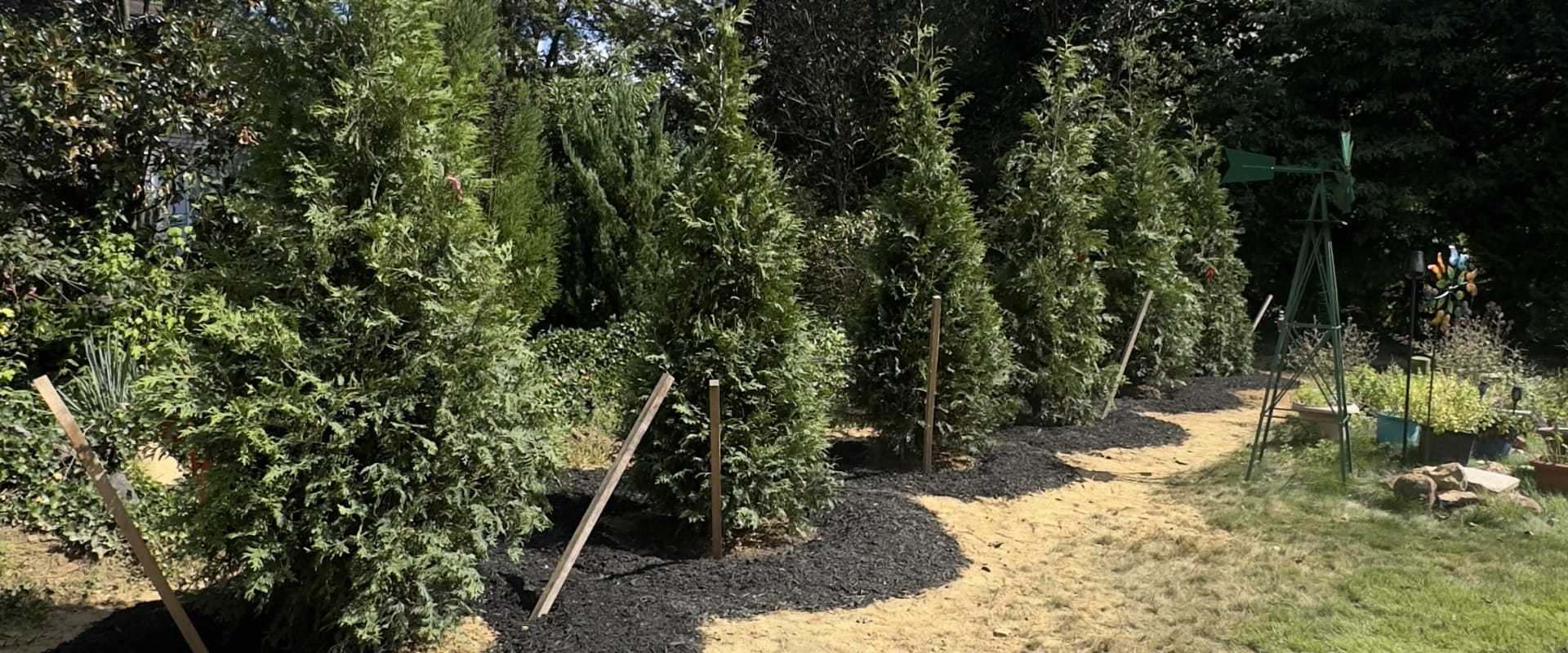
The Green Giant has become the most recommended privacy screen across Delaware and the wider mid-Atlantic. It combines fast growth, dense year-round foliage, and strong disease resistance. Unlike Leyland Cypress, Green Giant is highly resistant to the fungal diseases that thrive in Delaware's humid summers.
In our experience planting privacy screens across Wilmington, Newark, Bear, and Middletown since 2017, Green Giant Arborvitae installed at 6-foot spacing have achieved full privacy screening within four growing seasons in the vast majority of cases. It's the single most consistent performer we've seen across Delaware's range of soil types.
Green Giants maintain rich green color through all four seasons and require minimal maintenance once established. Space at 5-8 feet for a tight screen or 10-12 feet for a more natural look.
Nellie Stevens Holly (*Ilex × 'Nellie R. Stevens'*)
Growth rate: Fast (3 feet per year) | Mature size: 15-25 feet tall, 8-12 feet wide
Nellie Stevens Holly combines fast growth with dense glossy foliage and abundant red berries. Unlike American Holly, a single Nellie Stevens plant produces berries without requiring a separate male pollinator nearby. It tolerates partial shade, which is useful for fence-line screening that doesn't receive full sun all day.
Nellie Stevens Holly is deer-resistant and low-maintenance year-round. It's an excellent choice for suburban Delaware properties where you want an elegant, wildlife-friendly privacy screen without the scale of a Leyland Cypress or arborvitae hedge.
Serviceberry / Amelanchier (*Amelanchier canadensis*)
Growth rate: Moderate (1-2 feet per year) | Mature size: 15-25 feet tall, 10-15 feet wide
The Serviceberry is Delaware's finest small ornamental privacy and specimen tree, and it's criminally underplanted. It's native to the eastern United States, listed as a recommended native planting by the Delaware Department of Natural Resources and Environmental Control (DNREC). White flowers open in early spring before the leaves, followed by edible purple berries in June that attract over 35 species of birds.
Serviceberry is the only small tree on this list that delivers four distinct seasons of visual interest: spring flowers, summer berries, brilliant orange-red fall color, and attractive gray bark in winter. For smaller urban lots in Wilmington, Newark, and Dover where a full-size shade tree won't fit, Serviceberry delivers outsized ecological value in a compact form. It performs well in both full sun and partial shade, tolerates Delaware's clay soils, and requires almost no maintenance once established.
How Do You Plant Trees Successfully in Delaware?
Proper planting technique determines whether a young tree thrives or fails within its first three years. The University of Delaware Cooperative Extension reports that planting depth errors account for the majority of young tree failures in residential landscapes. Getting the fundamentals right at installation prevents years of decline.
Timing matters. Fall planting from September through November and early spring planting from March through April are the optimal windows for Delaware. Cooler soil temperatures reduce transplant stress and allow roots to establish before summer heat arrives. Avoid planting in July and August when soil temperatures above 80°F slow root development significantly.
Plant at the correct depth. The root flare, where the trunk widens at the base, must sit at or slightly above grade. Planting even two inches too deep restricts oxygen to roots and causes slow decline over years, not weeks. This is one of the most common errors we see on properties throughout New Castle County.
Water deeply in year one. Newly planted trees need consistent moisture through their first growing season. Deep, infrequent watering (once or twice per week to a depth of 12 inches) encourages roots to grow outward and downward. Shallow daily watering trains roots to stay near the surface.
Mulch correctly. Apply 2-4 inches of organic mulch over the root zone in a wide ring. Keep mulch 3-4 inches away from the trunk. "Mulch volcanoes" piled against the bark cause rot and create entry points for pathogens. DNREC recommends wood chip mulch over stone mulch for native tree plantings.
Match species to actual site conditions. Know your soil type, drainage, sun exposure, and mature space before you choose a species. The single most common planting mistake across Delaware is choosing a tree based on appearance at the nursery rather than what the site actually supports.
Professional Tree Planting vs. DIY: Which Makes More Sense?
For most Delaware homeowners, a single specimen tree under 6 feet tall is a manageable DIY project if the site conditions are straightforward. Anything beyond that carries real risk. The Arbor Day Foundation estimates that improperly planted trees cost American homeowners an average of $500-$3,000 in remediation and removal within the first ten years, often far exceeding the original tree cost.
Professional planting makes clear financial sense in several situations. Large balled-and-burlapped trees over 2.5-inch caliper require equipment and team coordination that reduces transplant stress dramatically. Privacy screen installations with multiple trees require precise spacing to avoid crowding problems five years out. Sites with drainage issues, clay soils, or slope require soil amendment decisions that benefit from professional assessment.
Contact Blue Rock Tree Care for a free tree planting consultation →
At Blue Rock Tree Care, we've been installing trees across Delaware, Pennsylvania, and Maryland since 2017. We provide proper spacing, correct planting depth, soil amendment where needed, and structural staking. Our landscaping and tree installation service covers everything from single specimen trees to full privacy screen installations throughout Wilmington, Newark, Bear, Glasgow, Middletown, Hockessin, Pike Creek, and surrounding areas.
Contact our team to schedule a free on-site consultation. We'll walk your property, assess your soil and drainage, and recommend the right species for your goals and budget.
Frequently Asked Questions About Tree Planting in Delaware
When is the best time to plant trees in Delaware?
Fall (September through November) and early spring (March through April) are the best planting windows in Delaware. Cooler soil temperatures in these seasons reduce transplant stress and allow roots to establish before summer heat or winter freeze arrives. The University of Delaware Cooperative Extension consistently recommends fall as the single best planting season for most deciduous trees in Zone 7.
What trees grow fastest in Delaware?
The fastest-growing trees for Delaware conditions are Green Giant Arborvitae (3-5 feet per year), Leyland Cypress (3-4 feet per year), Tulip Poplar (2-3 feet per year), and American Sycamore (2+ feet per year). For fast privacy screening, Green Giant Arborvitae is the most reliable choice across Delaware's range of soil types, with better disease resistance than Leyland Cypress in humid conditions.
Do I need a permit to plant a tree in Delaware?
In most Delaware municipalities, planting a tree on private property does not require a permit. However, planting near public right-of-way, utility easements, or in designated wetland buffers may require approval from your municipality or DNREC. Wilmington and Newark both have street tree programs with specific species lists and planting guidelines. Always check with your local municipality before planting within 10 feet of a property line or public sidewalk.
What native trees are best for Delaware wildlife?
White Oak, Tulip Poplar, Eastern Red Cedar, American Holly, and Serviceberry are the top five native trees for Delaware wildlife value. The University of Delaware Cooperative Extension reports that native oaks alone support more than 500 caterpillar species, which form the base of the food chain for nesting birds. Serviceberry provides early spring nectar for pollinators and June berries for over 35 bird species. Native trees consistently outperform non-native species for local ecological benefit.
How much does professional tree planting cost in Delaware?
Professional tree planting in Delaware typically ranges from $150 to $500 per tree for small to medium specimens (up to 2-inch caliper), and $500 to $2,000 or more for large balled-and-burlapped trees over 3-inch caliper. Privacy screen installations are typically priced per linear foot. Costs vary by species, size, site conditions, and soil amendment requirements. A free on-site consultation from a licensed Delaware tree service will give you an accurate project estimate. Request a free quote here.
Choosing the Right Trees for Your Delaware Property
Delaware's 2,000-square-mile footprint covers enough climate and soil variation to matter. The right tree for a backyard in Hockessin is not automatically the right tree for a coastal Sussex County property or a clay-heavy lot in Bear. Start with site conditions, then choose species, then consider aesthetics.
The 12 trees on this list represent the best performers across Delaware's full range of Zone 7a and 7b conditions. Red Maple and Pin Oak dominate suburban shade planting for good reason. Green Giant Arborvitae and Eastern Red Cedar lead privacy installations for equally good reasons. Bald Cypress and Serviceberry fill important ecological niches that the more popular species don't cover.
Plant deliberately. Give each tree the space it needs at maturity. Water correctly in the first year. Mulch properly. A tree planted right in 2026 will still be standing, shading, and providing habitat in 2076.
Our team at Blue Rock Tree Care provides professional tree installation and landscaping throughout Delaware. We've been helping homeowners in Wilmington, Newark, Dover, Bear, Glasgow, Middletown, Hockessin, and Pike Creek build better landscapes since 2017. Contact us at 302-408-0626 to schedule your free on-site consultation.