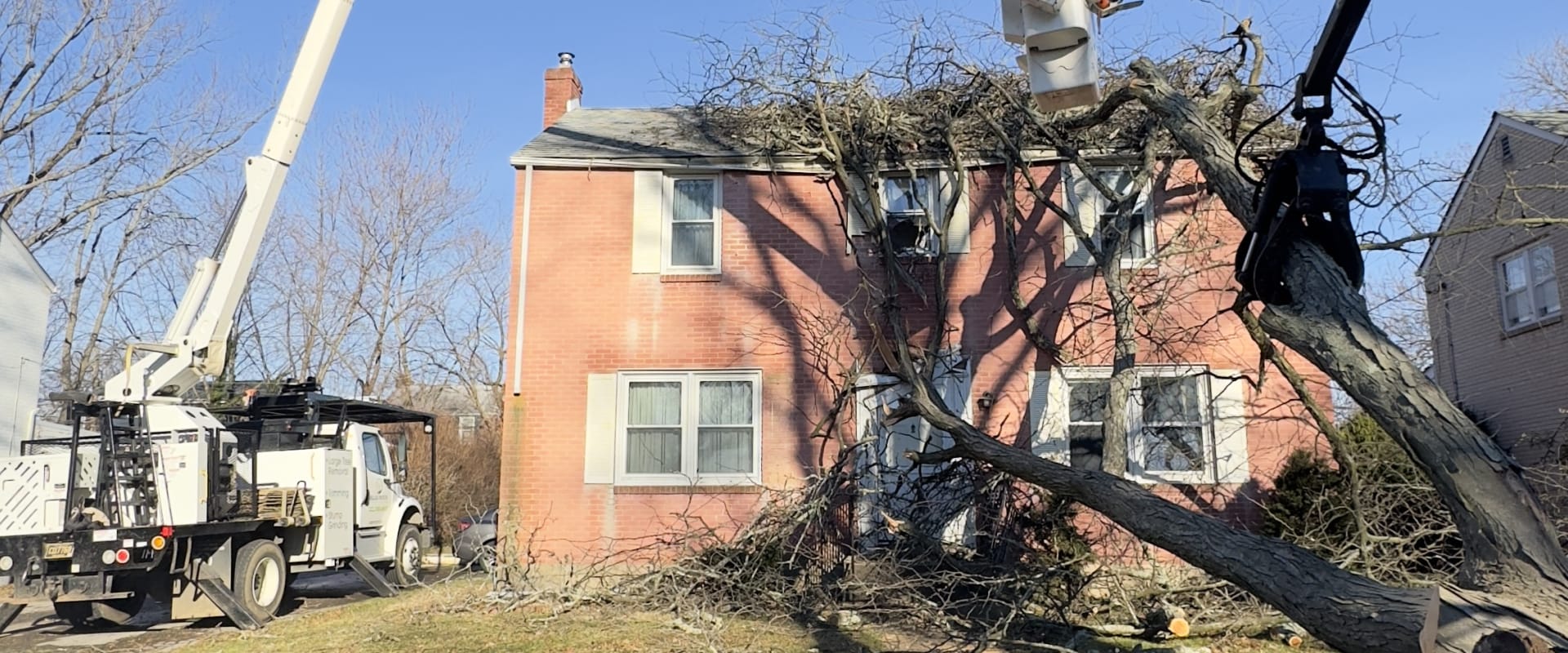
Emergency Tree Service in Delaware: What to Do When a Tree Falls (2026)
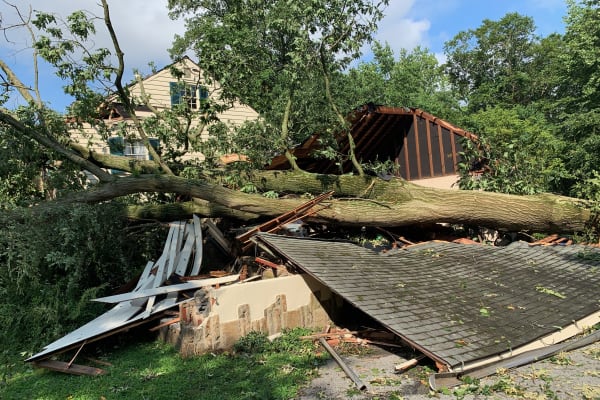
A tree just fell on your property. Every minute matters. Trees and falling limbs cause billions in property damage each year across the U.S., and the mid-Atlantic is no exception. According to the Insurance Information Institute, wind and hail claims account for over 45% of all homeowner insurance losses — and fallen trees are a leading driver. Here's what to do right now.
Related: How to Prepare Your Trees for Delaware Storm Season
Key Takeaways
- Get everyone out of the affected area immediately — don't go back inside until a professional clears it
- If the tree is touching power lines, call Delmarva Power at 800-375-7117 before anything else
- Document all damage with photos before any cleanup begins
- Emergency tree removal in Delaware costs $500-$5,000+ depending on size and complexity
- Blue Rock Tree Care is available 24/7 across all of Delaware — call 302-408-0626 any time
Step 1: What Are the Immediate Safety Steps?
The first five minutes after a tree falls determine whether a property damage situation becomes a personal injury situation. FEMA's post-disaster guidance is clear: evacuate the affected structure first, ask questions second. Structural damage from a fallen tree can be invisible to the eye, and secondary collapses happen.
Get everyone out of the building. Don't pause to grab belongings. A tree through a roof redistributes load in ways that can cause sudden secondary failure, especially in older construction common in Wilmington and Newark neighborhoods.
Once everyone is outside and at a safe distance, do a quick visual check:
- Is the tree still moving or settling?
- Are any branches still suspended above the structure (called "widow makers")?
- Is there any smell of gas?
If you smell gas, move farther away and call 911. A fallen tree can rupture gas lines. Don't re-enter for any reason until emergency services give the all-clear.
Keep a 50-foot perimeter around any large fallen tree. Root balls can spring back. Heavy limbs under tension can snap. These hazards are real and fast.
In our years of emergency response across New Castle County, the calls that go wrong are almost always ones where a homeowner went back inside to "just grab something" before we arrived. Don't do it.
Step 2: Is the Tree Touching Power Lines?
If the fallen tree is in contact with any power line, treat every wire on the ground as live. This is the single most dangerous scenario in any tree emergency. According to the Electrical Safety Foundation International (ESFI), downed power lines cause hundreds of electrocutions in the U.S. each year.
Call Delmarva Power immediately: 800-375-7117. They operate 24 hours a day and will dispatch a crew to de-energize the line before any tree work can safely begin. No tree service — including ours — will touch a tree in contact with live wires until the utility confirms power is off.
What Not to Do Near Downed Power Lines
- Don't touch the tree, even if it looks clear of wires
- Don't walk through standing water near the tree
- Don't try to move the line yourself
- Don't assume a line is dead because the lights in the house are off
Delmarva Power serves most of Delaware. If you're in an area served by a different utility, the same rules apply — call them first, not the tree company.
Downed power lines from storm-damaged trees are among the leading causes of electrocution in the U.S. The Electrical Safety Foundation International (ESFI) reports that contact with overhead power lines accounts for a significant share of electrical fatalities each year. In Delaware, Delmarva Power's 24-hour outage line (800-375-7117) must be called before any emergency tree work begins near energized lines.
Step 3: How Should You Document the Damage?
Once the scene is safe — no power lines involved, no gas smell, structure isn't actively collapsing — document everything before a single branch is moved. Insurance adjusters and FEMA disaster assistance programs require photographic proof of the damage as it occurred.
Use your phone to capture:
- Wide shots of the full scene from multiple angles
- Close-ups of where the tree entered the structure
- Any crushed vehicles, fences, or outbuildings
- The root ball or base of the tree (this helps establish cause)
- Interior damage if it's safe to briefly enter
In our experience handling insurance-related tree jobs across Delaware, homeowners who photograph before cleanup receive settlements that average significantly higher than those who start cutting before documenting. Insurers need to see the original extent of damage.
Timestamp matters. Most phone cameras embed time and GPS data in photo metadata automatically, but take a quick screenshot of the clock too. If you have a security camera system that captured the event, save or export that footage immediately before it overwrites.
Step 4: How Do You Choose an Emergency Tree Service?
Not every tree company that advertises "24/7" actually answers the phone at 2 a.m. on a Tuesday in January. When you call for emergency tree service in Delaware, the right questions separate real emergency arborists from companies that return your call the next morning.
Ask these four questions when you call:
- Are you available right now, tonight?
- Are you licensed and insured in Delaware?
- Do you carry liability AND workers' comp coverage?
- Can you provide a written estimate before work starts?
View our full list of tree care services →
Licensing and insurance aren't paperwork formalities. If an uninsured crew damages your roof further or a worker gets injured on your property, your homeowner policy may be on the hook. The International Society of Arboriculture (ISA) recommends verifying insurance certificates directly — not just taking a company's word for it.
Blue Rock Tree Care carries full liability insurance and workers' compensation, holds USDOT #2970749, and has served Delaware homeowners since 2017. When you call 302-408-0626, a real person answers — any time, any day.
What Emergency Tree Crews Assess On Arrival
- Structural stability of the affected building
- Whether additional trees on the property are compromised
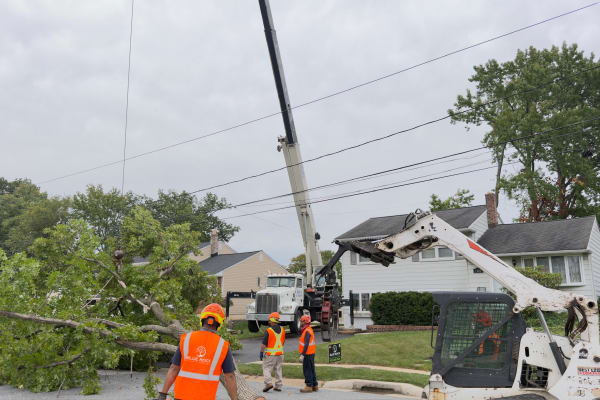
- Equipment access (crane vs. chainsaw-only removal)
- Debris volume and haul-away logistics
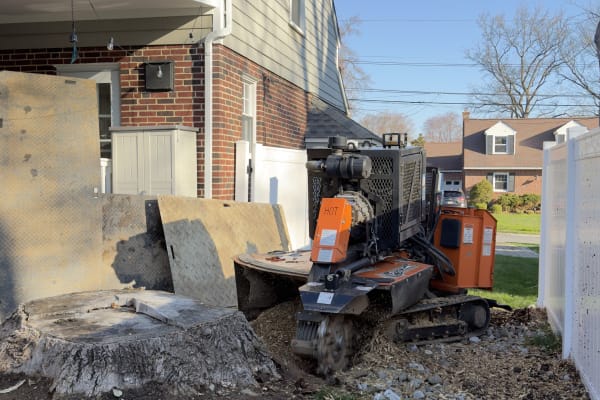
- Whether stump grinding is needed before the site is usable
Step 5: When Should You Contact Your Homeowners Insurance?
Call your insurance company the same day as the incident, ideally within a few hours. Most homeowner policies have provisions for emergency tree removal, but the details vary widely. The Insurance Information Institute reports that standard HO-3 policies typically cover tree removal if the tree damages a covered structure — meaning the house, garage, or fence, not just the lawn.
What's usually covered:
- Tree removal costs when a tree falls on an insured structure
- Structural repair to the home or garage
- Temporary emergency repairs (tarps, board-ups) to prevent further damage
What's usually NOT covered:
- Removing a fallen tree that missed your house
- Removing a standing dead tree that didn't fall yet
- Damage from a tree you were previously warned about
Document your call with the insurer: get a claim number, the adjuster's name, and a written summary of next steps. Your emergency tree removal invoice is part of the claim package, so get itemized receipts.
Contact Blue Rock Tree Care for emergency assistance →
What Does Emergency Tree Removal Cost in Delaware?
Emergency tree removal in Delaware costs more than standard scheduled removal, and it should — crews mobilize at night, in bad weather, with urgent timelines and higher risk. The after-hours premium typically runs 20-30% above standard rates, according to industry pricing data from the Tree Care Industry Association (TCIA).
Here are realistic cost ranges for common emergency scenarios in Delaware:
| Scenario | Typical Cost Range |
|---|---|
| Fallen tree on house or roof | $1,500 - $5,000+ |
| Tree blocking road or driveway | $500 - $1,500 |
| Large tree down in yard (no structure) | $800 - $2,500 |
| Multiple storm-damaged trees | Varies; bulk pricing often available |
| Emergency limb removal (hazard branch) | $300 - $900 |
Factors that push costs higher: crane-required jobs, trees tangled in power lines (requiring utility coordination), severe roof penetration requiring tarp and temporary repair, and debris volume requiring multiple haul-away trips.
Get a written estimate before work starts. A reputable emergency arborist will assess the scene and give you a number in writing, even at 3 a.m.
Why Does 24/7 Emergency Tree Service Matter in Delaware?
Delaware's location on the mid-Atlantic coast puts it in the path of multiple severe weather patterns each year. NOAA data shows the Delaware and Chesapeake Bay region experiences an average of 8-12 significant storm events annually, including nor'easters from October through April, tropical storm remnants from June through November, and severe convective thunderstorms in summer.
A tree on your roof at midnight isn't a problem you can wait until morning to solve. Rain entering through the breach causes interior water damage that compounds by the hour. Mold can begin forming within 24-48 hours of water intrusion, according to EPA guidelines. Every hour the tree sits on the structure is more water, more damage, more money.
Delaware's clay-heavy soil — common throughout New Castle County from Wilmington down through Bear and Glasgow — saturates quickly during heavy rain. Saturated clay dramatically reduces root anchorage. Trees that looked perfectly healthy can topple in storms because the soil itself failed, not the tree. This is why post-storm hazard assessment matters even for trees that didn't fall.
Nor'easters are Delaware's most underappreciated tree threat. They move slowly, sometimes stalling for 12-24 hours, piling up wet, heavy snow or ice on canopy. The cumulative load on branches and root systems exceeds what a fast-moving hurricane can deliver in many cases. Wilmington, Hockessin, Pike Creek, and Newark regularly see the heaviest impacts from these systems.
What Does Blue Rock Tree Care's Emergency Response Look Like?
When you call 302-408-0626, here's what happens. A real crew member — not an answering service — picks up the phone. We ask for your address, a quick description of the situation, and whether power lines are involved. If they are, we coordinate with Delmarva Power before dispatch.
Our team arrives with professional equipment: chainsaws, rigging systems, a chipper, and on large jobs, crane access. We assess structural risk to the home before starting, tarp roof penetrations as we go, and haul debris off-site.
We serve all of Delaware — New Castle County including Wilmington, Newark, Bear, Glasgow, Hockessin, Pike Creek, and New Castle; Kent County including Dover and surrounding areas; and Sussex County. We've been doing this since 2017, and every crew member understands that an emergency call isn't just a job — it's someone's home.
After the immediate hazard is resolved, we provide a full written assessment of any remaining at-risk trees on the property at no additional charge. Knowing what's still standing — and whether it's safe — is part of the job.
How Can You Prevent Future Tree Emergencies?
The best emergency tree service call is the one you never have to make. Most fallen tree emergencies are preventable with routine inspection and proactive maintenance. The ISA recommends professional tree inspection every 1-3 years for mature trees, and annually for any tree within striking distance of a structure.
9 Warning Signs Your Tree Needs to Come Down →
High-priority prevention steps for Delaware homeowners:
- Have large trees professionally inspected before storm season (April and October are ideal)
- Remove dead or heavily declining trees before the next storm arrives
- Address co-dominant stems and included bark — structural defects that make trees far more likely to split
- Keep a 10-foot clearance between major limbs and your roofline where possible
- After any major storm, have a professional walk the property — not just the trees that fell, but the ones that didn't
Read our full storm prep checklist →
Stump grinding after removal also matters. Left stumps can host decay fungi that spread to adjacent healthy trees, weakening root systems over time. Prevention is always cheaper than emergency response.
Frequently Asked Questions
Does homeowners insurance cover emergency tree removal in Delaware?
It depends on where the tree landed. The Insurance Information Institute confirms that standard HO-3 homeowner policies typically cover tree removal costs when a fallen tree damages an insured structure — your house, attached garage, or fence. If the tree fell in your yard without hitting anything, removal is usually not covered. Always file a claim the same day and get a claim number before cleanup begins.
How fast can you respond to a tree emergency in Delaware?
Blue Rock Tree Care responds to emergency calls across Delaware 24 hours a day, 7 days a week. Response time varies by location and current call volume, but we aim to be on-site within 1-2 hours for active emergencies. For situations involving structural damage or trees in contact with power lines, we prioritize dispatch and coordinate with Delmarva Power when needed. Call 302-408-0626 any time.
Is it safe to stay in my house if a tree fell on the roof?
Do not assume it's safe. A tree on a roof changes the load distribution of the entire structure. What looks stable can shift suddenly. FEMA recommends evacuating any structure with roof penetration or visible structural deformation until a professional assessment is complete. If you can see sky through the ceiling or the roof line looks different, get out and stay out until the tree is removed and an inspector clears re-entry.
Who is responsible if a neighbor's tree falls on my property in Delaware?
Delaware follows general common law: if a neighbor's tree falls on your property, your homeowner's insurance typically covers your damage — regardless of who owned the tree. However, if you previously notified the neighbor in writing that their tree was dead or diseased and they failed to act, they may bear liability. Document any prior notices. Consult a Delaware attorney if the damage is significant and you believe negligence applies.
Can I cut up a fallen tree myself?
For small branches and debris, yes. For any tree that is on a structure, touching a power line, or under tension (bent or pinned), do not attempt DIY cutting. Trees under load can spring violently when cut — a phenomenon called "kickback" that injures even experienced operators. The ISA recommends leaving tension-loaded removal to trained professionals with proper rigging equipment. The cost of professional removal is almost always less than the ER visit if something goes wrong.
Blue Rock Tree Care is a licensed and insured tree service based in Delaware, serving Wilmington, Newark, Dover, Bear, Glasgow, Middletown, Hockessin, Pike Creek, and all of New Castle, Kent, and Sussex Counties. For 24/7 emergency tree service, call 302-408-0626.